Why it exists
The gap between data and decision
Health systems generate enormous amounts of information.
Blood tests, imaging, symptoms, wearable signals, medical histories, lifestyle data and clinical observations can all tell us something important.
But information does not automatically become understanding.
A person can receive a test result without knowing what it means.
A clinician can see a single value without the full trend.
A researcher can study populations without access to structured real-world follow-up.
A laboratory can produce accurate diagnostics without being connected to the decision that follows.
A digital product can collect data without creating real clinical value.
High Coast Health Intelligence Institute exists to close this gap.
We are building the structure between health data and better health decisions.
Health needs more context
Many health decisions are still made from limited snapshots.
One consultation.
One blood test.
One symptom description.
One moment in time.
But human biology is dynamic.
Inflammation, metabolism, hormones, recovery, pregnancy development, cardiovascular risk and long-term health all change over time.
A single measurement can be useful, but a pattern is often more meaningful.
That is why we focus on structure, trends and context.
We want to help people understand not only what a result shows today, but what it may mean over time.
Prevention needs better systems
Preventive health is often discussed as an ideal, but it needs practical infrastructure.
It needs diagnostics that measure relevant signals.
It needs interpretation that connects results to personal context.
It needs expert review when needed.
It needs structured programs that help people act.
It needs follow-up over time.
It needs responsible learning from real-world outcomes.
Without this structure, prevention becomes vague.
High Coast Health Intelligence Institute exists to make prevention more measurable, actionable and useful.
Patients need clarity
Many people want to take better care of their health, but they are left with fragmented information.
They may have test results, symptoms, lifestyle concerns or previous health events — but no clear way to connect them.
This is especially true in areas where standard care may not offer close follow-up unless there is an obvious medical problem.
Examples include early pregnancy concern, long-term health optimization, inflammation, metabolic risk, recovery, fatigue and preventive health.
The Institute exists to create structured pathways where people can move from concern to measurement, interpretation, guidance and follow-up.
The goal is not to replace healthcare.
The goal is to create better support around the decisions that matter.
Clinicians need better tools
Clinicians often work under pressure, with limited time and incomplete information.
At the same time, health data is becoming more complex.
AI-supported systems can help structure information, identify trends, highlight risk patterns and prepare better decision support.
But AI alone is not enough.
Clinical judgment remains essential.
High Coast Health Intelligence Institute exists to combine AI-supported interpretation with human expertise, so that clinicians and experts can focus on the decisions where their knowledge matters most.
Research needs real-world learning
Many important health questions cannot be fully answered in isolated settings.
We need to understand what happens in real life:
How do biomarkers change over time?
Which patterns predict better or worse outcomes?
Which interventions seem to help which people?
Which signals should trigger closer follow-up?
Which products or programs create measurable value?
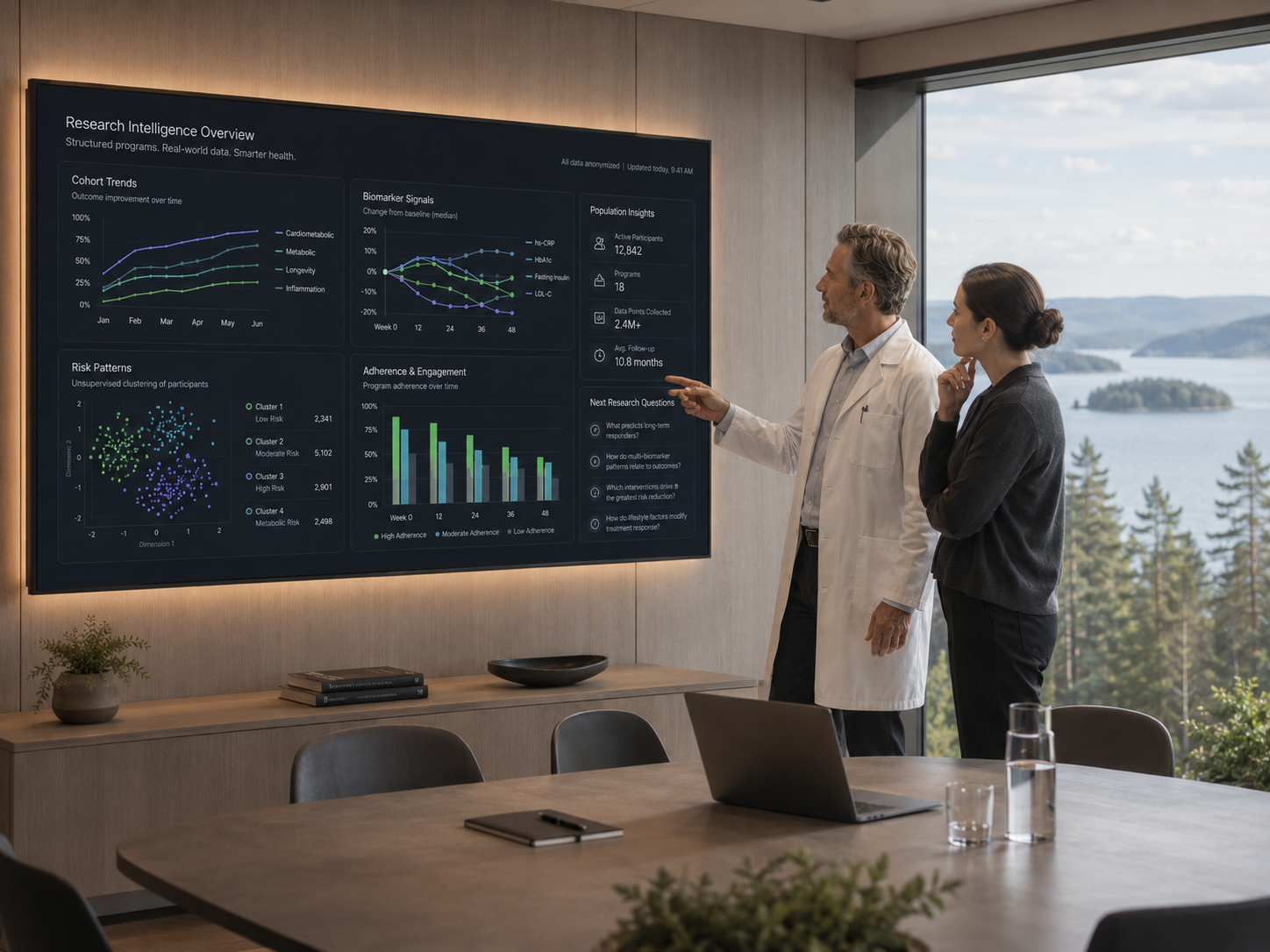
Structured programs can become learning systems when data is collected responsibly and interpreted carefully.
This is one of the reasons the Institute exists.
We want to connect real-world health programs with research, model development and product innovation.
Partners need a platform
Health innovation often fails because good ideas remain disconnected.
A laboratory may have strong testing capacity.
A researcher may have a promising model.
A clinician may see an unmet need.
A product developer may have a useful tool.
A region may have the right environment.
An investor may want to support meaningful health innovation.
But without a shared platform, these parts may never become a working system.
High Coast Health Intelligence Institute exists as a meeting point for these capabilities.
We aim to build a platform where partners can develop, test, validate and scale health intelligence solutions.
Why the High Coast
The Institute is built in the High Coast because the place itself supports the vision.
The region offers nature, space, recovery, perspective and a strong environment for long-term thinking.
It is a setting where science and human experience can meet.
But the ambition is not local only.
The High Coast is the base.
The model is distributed.
The solutions should be useful everywhere.
The reason behind the Institute
High Coast Health Intelligence Institute exists because better health decisions require more than isolated data.
They require structure.
They require diagnostics, interpretation, expert networks, AI systems, real-world programs and research working together.
We believe that when these parts are connected, health knowledge becomes more useful.
And when knowledge becomes useful, it can change decisions.
Better decisions can lead to better lives.