Program Formats
Different formats for structured health intelligence
Program Formats describe how health intelligence programs can be delivered through High Coast Health Intelligence Institute.
Not every health need requires the same format.
Some people need digital monitoring.
Some need diagnostics and clinical review.
Some need structured follow-up over time.
Some need a short intensive program.
Some may benefit from a retreat-based or environment-supported experience.
Some programs may be delivered directly by the Institute, while others may be delivered together with partners.
The format can vary.
The core model remains the same:
human need
diagnostics and data
AI-supported interpretation
expert guidance
actionable health decisions
structured follow-up
learning over time
The purpose is to make health intelligence practical in different real-world situations.
Why format matters
A strong program is not only defined by what it measures.
It is also defined by how it is experienced.
The same health question can require different formats depending on:
the person’s need
the level of medical sensitivity
the need for testing
the need for follow-up
the need for expert review
the complexity of the data
the desired level of support
whether the program is digital, physical or hybrid
Pregnancy monitoring may require rapid response and careful communication.
Longevity programs may require deeper assessment, lifestyle guidance and long-term tracking.
Preventive diagnostics may require interpretation and follow-up after testing.
Research programs may require structured data collection and consent-based learning.
Program Formats help match the structure to the need.
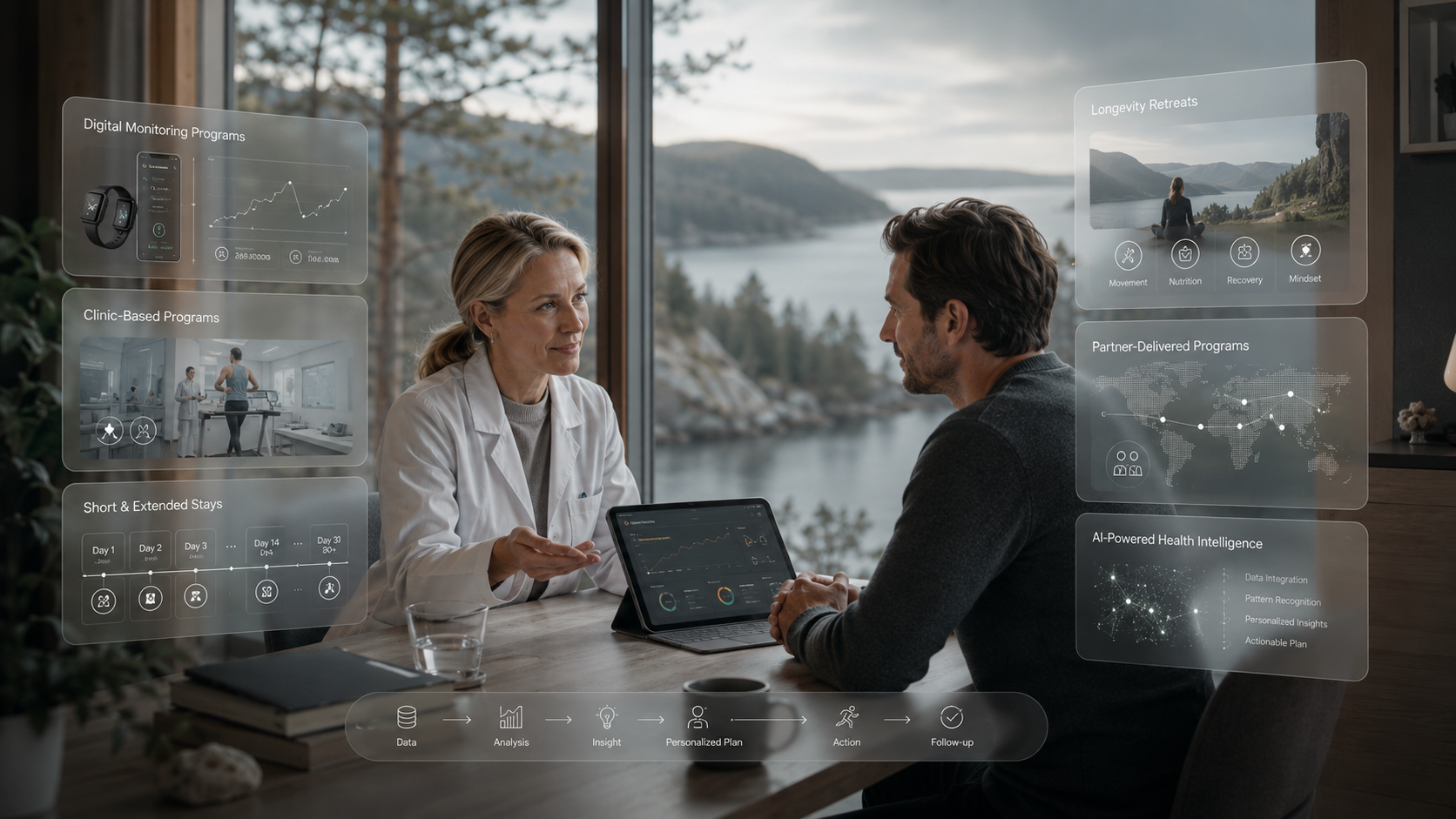
Digital monitoring programs
Digital monitoring programs allow health intelligence to continue outside a physical location.
They can support participants through:
symptom tracking
biomarker trend review
test result summaries
AI-supported interpretation
follow-up reminders
digital dashboards
structured questionnaires
trigger-event reporting
expert review when needed
Digital monitoring is especially relevant when a person needs repeated follow-up over time.
In Pregnancy Intelligence, digital monitoring may support early pregnancy tracking, symptom logs, bleeding episode documentation and biomarker trend review.
In Longevity Intelligence, digital monitoring may support long-term biomarker tracking, recovery data, lifestyle patterns and follow-up after interventions.
Digital programs are not meant to replace clinical care.
They are meant to create structure, continuity and better access to health intelligence.
Clinic-based programs
Clinic-based programs connect diagnostics, consultation and expert interpretation in a physical or clinical setting.
This format may be useful when testing, examination, expert review or clinical responsibility is central to the pathway.
Clinic-based programs may include:
blood testing
biomarker panels
medical history review
clinical consultation
physical assessment
interpretation of results
risk prioritization
follow-up planning
referral guidance when needed
This format is especially relevant for preventive diagnostics, pregnancy monitoring and more medically sensitive health questions.
A clinic-based program can create a stronger connection between measurement and responsibility.
Short and extended stays
Some programs may benefit from a short or extended stay format.
This can create time and space for more complete assessment, reflection, education and planning.
A short or extended stay may include:
diagnostic testing
baseline assessment
consultations
education sessions
recovery routines
sleep and stress support
nutrition and lifestyle review
movement or physical capacity assessment
follow-up planning
digital continuation after the stay
This format may be especially relevant for longevity, recovery, performance, preventive health and future project areas.
A stay format allows health intelligence to become more than a report.
It becomes an experience where data, guidance, routines and environment can come together.
Longevity retreats
Longevity retreats are one possible program format within Longevity Intelligence.
A retreat-based program can combine diagnostics, education, recovery, environment and structured health planning.
The High Coast setting can support this format through:
nature
space
low noise
seasonality
recovery
physical activity
reflection
long-term thinking
But the environment is not the program by itself.
A serious longevity retreat should be built around structure:
baseline assessment
diagnostics
biological risk review
AI-supported interpretation
expert guidance
personalized priorities
recovery and lifestyle routines
follow-up after the retreat
The goal is not a wellness escape.
The goal is health intelligence translated into a lived experience.
Partner-delivered programs
High Coast Health Intelligence Institute is built as a distributed model.
This means some programs may be developed or delivered together with partners.
Partner-delivered programs may involve:
healthcare providers
diagnostic laboratories
research groups
AI and software companies
hospitality partners
regional stakeholders
product developers
specialist clinicians
coaches or program teams
A partner-delivered format can expand reach and capability.
The Institute may provide the program model, data structure, interpretation framework, research logic or brand platform, while partners contribute local delivery, diagnostics, expertise, technology or experience.
The key is alignment.
Partner-delivered programs should follow the same standards for quality, responsibility and health intelligence.
Hybrid program formats
Many programs will likely be hybrid.
A participant may begin digitally, complete laboratory testing through a partner, receive expert interpretation remotely, attend a physical consultation, and then continue follow-up through a digital program.
Hybrid formats can combine the strengths of multiple delivery models:
digital continuity
clinical responsibility
laboratory access
expert guidance
physical experience
long-term follow-up
This may become one of the most important formats for the Institute.
Hybrid programs allow health intelligence to be both scalable and human.
Program formats in Pregnancy Intelligence
Pregnancy Intelligence may use several formats depending on need and sensitivity.
Possible formats include:
digital early pregnancy monitoring
clinic-based blood testing
IVF-support monitoring
bleeding episode response
high-concern pregnancy pathway
post-result guidance
expert review when needed
Because early pregnancy can be medically and emotionally sensitive, the format must be careful.
Digital support may help structure information, but human expertise and appropriate healthcare boundaries remain important.
The goal is to create clarity, not false certainty.
Program formats in Longevity Intelligence
Longevity Intelligence may use broader and more flexible formats.
Possible formats include:
digital longevity monitoring
baseline health assessment
advanced longevity assessment
clinic-based diagnostics
recovery and performance programs
short and extended stays
retreat-based programs
long-term follow-up
Longevity programs often require time.
A person may need baseline diagnostics, interpretation, action planning, lifestyle changes and repeated measurement.
This makes hybrid and long-term formats especially useful.
Program formats in Preventive Diagnostics
Preventive diagnostics can also be delivered through several formats.
A person may start with a testing panel, receive structured interpretation, identify priorities and continue with follow-up.
Possible formats include:
single diagnostic assessment
preventive biomarker panel
repeat testing pathway
digital result interpretation
expert review
program referral
follow-up after intervention
The important point is that testing should not end with the result.
The result should be connected to guidance and next steps.
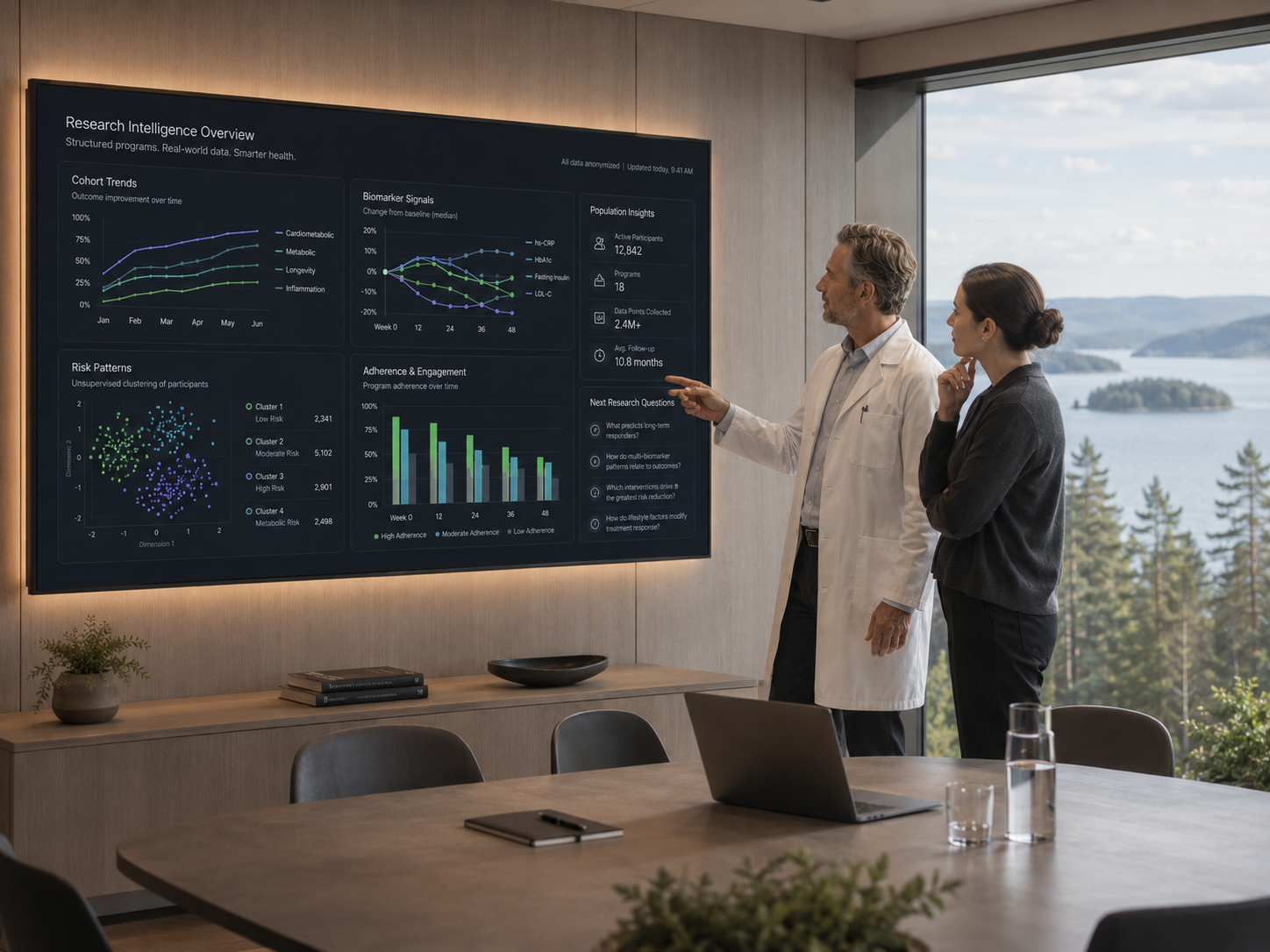
Program formats in Research Intelligence
Research Intelligence may use program formats that support responsible learning.
This can include:
consent-based data collection
structured digital follow-up
program outcome tracking
pilot programs
research cohorts
partner studies
model development pathways
publication and white paper development
Research formats must be carefully governed.
They should protect privacy, respect consent and generate knowledge that can improve future health intelligence.
Choosing the right format
The right program format depends on the health question.
Some questions are simple and can be handled digitally.
Some require testing.
Some require clinical interpretation.
Some require repeated follow-up.
Some benefit from being experienced in a physical setting.
Some require partner expertise.
The Institute’s role is to match the format to the need.
The question should not be:
Which format do we want to sell?
The better question is:
Which format actually helps this person, this program or this health problem?
Quality across formats
No matter which format is used, quality matters.
Each program format should be built around:
clear purpose
relevant diagnostics
responsible data use
AI-supported structure
human expertise when needed
privacy and consent
realistic recommendations
follow-up logic
learning over time
A digital program should still be responsible.
A retreat should still be structured.
A partner-delivered program should still follow standards.
A clinic-based program should still connect to follow-up.
The format can change.
The quality principles should remain stable.
From format to pathway
A format becomes valuable when it creates a pathway.
A digital dashboard alone is not a program.
A lab test alone is not a program.
A retreat alone is not a program.
A consultation alone is not a program.
A program connects these parts into a structured process:
assessment
measurement
interpretation
guidance
action
follow-up
learning
This is what makes program formats part of health intelligence.
The core idea
Program Formats make health intelligence usable in different ways.
Digital monitoring programs.
Clinic-based programs.
Short and extended stays.
Longevity retreats.
Partner-delivered programs.
Hybrid pathways.
Each format can serve a different need, but all should support the same goal:
turn health data into better decisions, practical action and structured follow-up over time.