
A forensic framework for understanding vaginal bleeding in weeks 18–24 of pregnancy
A woman arrives with vaginal bleeding in mid-pregnancy.
She may be 18, 20, 22 or 24 weeks pregnant.
The usual clinical questions are immediate and necessary.
How much bleeding is there?
Is there pain?
Is the cervix opening?
Is there infection?
Is the placenta involved?
Is the fetus alive?
Is delivery imminent?
These are essential questions.
But there is another question that is rarely placed at the center:
What is the bleeding itself trying to tell us?
The blood came from somewhere.
It has been in contact with tissues.
It has moved through biological environments.
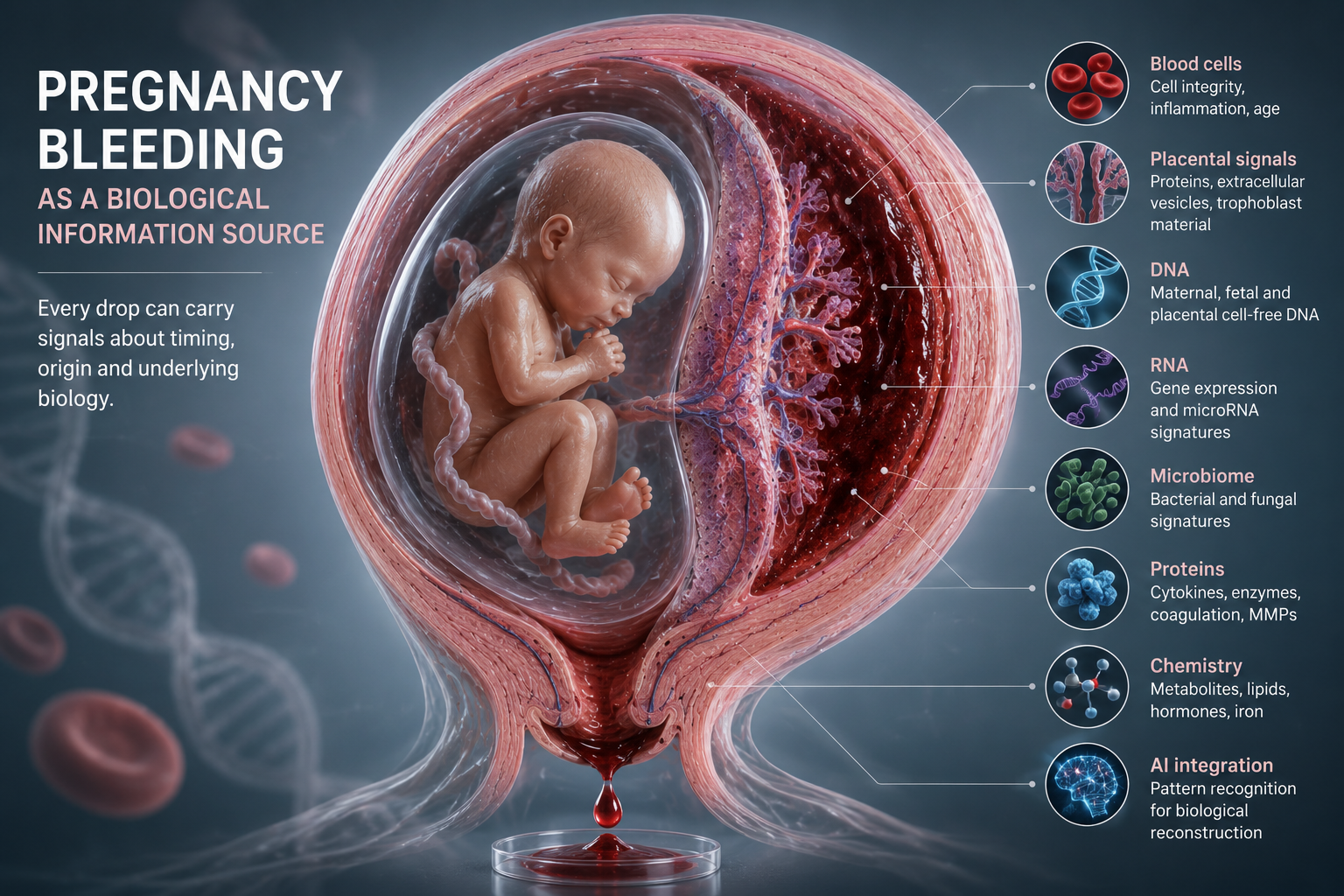
It may contain cells, proteins, metabolites, microbes, DNA, RNA, inflammatory signals and fragments of tissue.
In other words, pregnancy bleeding is not just a symptom.
It may be a biological specimen.
And if we treated it more like a forensic sample, we might begin to ask deeper questions:
When did the bleeding occur?
Where did it come from?
What tissue was involved?
What biological process caused it?
Could it predict what happens next?
This article explores that framework.
Not as a finished diagnostic model, but as a starting point for research.
Bleeding Is Not Just Blood
A vaginal bleeding sample in pregnancy may contain far more than red blood cells.
Depending on the source and timing, it may include:
- maternal blood cells
- degraded red blood cells
- white blood cells
- inflammatory cells
- cervical cells
- vaginal epithelial cells
- decidual cells
- trophoblast-derived material
- placental proteins
- fetal DNA
- fetal cells
- membrane-related proteins
- mucus
- fibrin
- clots
- bacteria
- fungi
- metabolites
- hormones
- immune signals
- extracellular vesicles
- tissue fragments
This means the sample may carry traces of the environment where the bleeding started.
A fresh cervical bleed, an old decidual hematoma, a placental-interface bleed, an infection-associated bleed and a membrane-related bleed may not produce identical biological material.
They may all appear clinically as “vaginal bleeding.”
But biologically, they may be different events.
The Forensic Question
A forensic investigator does not look at blood only as blood.
They ask:
Where did it come from?
How old is it?
What was it exposed to?
What cells are present?
What chemistry has changed?
What pattern does it form?
What does it say about the event?
Pregnancy bleeding can be approached in a similar way.
The sample may contain evidence about:
- Timing — when the bleeding occurred.
- Origin — where the bleeding came from.
- Tissue involvement — which structures contributed material.
- Mechanism — inflammation, infection, vascular injury, hematoma, membrane stress or placental-interface disturbance.
- Risk — whether the bleeding pattern may be associated with future complications.
This does not mean every sample can answer every question.
But it does mean that the bleeding itself may contain more information than is usually extracted.
1. What Can We Learn by Looking at the Sample?
The first layer is visual.
Even before laboratory testing, bleeding carries macroscopic information.
Color
Bright red blood suggests more recent or active bleeding.
Dark red or brown blood suggests older blood that has undergone oxidation and degradation.
Very dark brown bleeding may indicate blood that has been retained for some time before being expelled.
Texture
Watery blood may suggest dilution with fluid.
Thick blood may suggest clotting.
Mucus-mixed blood may suggest cervical or vaginal passage.
Stringy or gelatinous material may reflect mucus, fibrin or partially organized clot.
Clots
Clots indicate that blood has coagulated.
The size, number and consistency of clots may provide clues about whether bleeding was brief, repeated, heavy or retained.
Tissue-like Material
Fragments may contain decidual tissue, placental-interface material, cervical tissue, membrane material or nonspecific cellular debris.
Visual inspection cannot determine the full cause, but it begins the forensic description.
The first question is not simply: “How much blood?”
It is also: “What kind of bleeding material is this?”
2. What Can Microscopy Reveal?
Under the microscope, the sample becomes more informative.
A simple blood smear from a vein is usually clean and organized.
Vaginal bleeding in pregnancy is different.
It may be mixed, degraded and biologically complex.
Microscopy could show:
- intact red blood cells
- fragmented red blood cells
- ghost cells
- platelets
- neutrophils
- macrophages
- hemosiderin-laden macrophages
- squamous epithelial cells
- cervical glandular cells
- decidual cells
- trophoblast-like cells
- fibrin strands
- bacteria
- yeast forms
- necrotic debris
- mucus
- tissue fragments
A fresh bleed may show many intact red blood cells.
An older bleed may show degraded erythrocytes, pigment, cellular debris and macrophage activity.
An inflammatory bleed may show many white blood cells.
A sample associated with a hematoma may show fibrin, old blood products and organized debris.
A sample passing through the cervix or vagina may collect epithelial cells and microbiome signatures.
Microscopy therefore helps move the sample from “blood” toward “biological evidence.”
3. Can We Estimate the Age of the Bleed?
Blood changes over time.
Red blood cells break down.
Hemoglobin oxidizes.
Iron is released.
Macrophages clear debris.
Pigments accumulate.
DNA and RNA degrade.
Proteins change.
Microbial activity may increase.
A forensic-style analysis could examine:
- red blood cell preservation
- hemoglobin oxidation
- methemoglobin
- bilirubin-related products
- hemosiderin
- macrophage activity
- fibrin organization
- clot structure
- DNA degradation
- RNA degradation
- protein degradation
- bacterial overgrowth
This may not produce an exact timestamp.
But it may help classify bleeding as:
- very recent
- hours old
- days old
- repeated
- chronic
- old hematoma draining
- old bleeding with new bleeding added
This distinction is important.
A woman presenting with brown bleeding at week 20 may not be experiencing a new acute bleeding event. She may be draining an older hematoma.
Or she may have old blood mixed with fresh bleeding.
These are different biological situations.
4. Where Did the Bleeding Come From?
The central forensic question is tissue of origin.
Possible sources include:
- vagina
- cervix
- decidua
- placenta
- fetal membranes
- uterine wall
- hematoma cavity
- maternal-fetal interface
Each source may leave different traces.
Vaginal Source
May include squamous epithelial cells, vaginal microbiome patterns, local inflammation and mucosal markers.
Cervical Source
May include cervical mucus, glandular cells, squamous cells and local inflammatory cells.
Decidual Source
May include decidual stromal cells, old blood products, inflammatory mediators and tissue-remodeling signals from the pregnancy lining.
Placental Interface
May include trophoblast-derived material, placental proteins, placental extracellular vesicles or placental DNA methylation patterns.
Membrane Involvement
May include fetal membrane proteins, amniotic-related markers, inflammatory signals or membrane-degradation products.
A bleeding sample may therefore act as a biological map of the tissues involved.
5. What Can Microbiology Tell Us?
Pregnancy bleeding may also carry microbial information.
A sample could be analyzed for:
- Lactobacillus dominance
- bacterial vaginosis-associated organisms
- Gardnerella
- Atopobium
- Ureaplasma
- Mycoplasma
- Group B Streptococcus
- E. coli
- Enterococcus
- Candida
- Trichomonas
- Chlamydia
- Gonorrhea
- HSV and other viral material
This matters because infection and inflammation are closely connected to cervical change, membrane weakening, uterine activation and preterm birth pathways.
A bleeding sample may therefore reveal more than bleeding.
It may reveal the inflammatory and microbial environment around the reproductive tract.
6. What Can Chemistry Reveal?
The chemical composition of the sample may provide another layer of information.
Potential measurements include:
- pH
- lactate
- glucose
- amino acids
- fatty acids
- iron products
- heme degradation products
- oxidative stress markers
- prostaglandins
- lipid mediators
- cytokines
- chemokines
- complement activation products
- coagulation proteins
- fibrin degradation products
- matrix metalloproteinases
These chemical signals may help distinguish different biological mechanisms:
- inflammatory bleeding
- infection-associated bleeding
- vascular injury
- tissue breakdown
- placental stress
- membrane remodeling
- hematoma degradation
- coagulation activation
In this view, chemistry does not merely describe the sample.
It may help reconstruct the process that produced it.
7. What Can Proteomics Add?
Proteomics asks which proteins are present and in what pattern.
A pregnancy bleeding sample may contain proteins from:
- maternal blood
- decidua
- cervix
- vagina
- placenta
- fetal membranes
- immune cells
- microbes
Relevant protein groups may include:
- placental proteins
- inflammatory cytokines
- chemokines
- angiogenic factors
- anti-angiogenic factors
- matrix-remodeling enzymes
- complement proteins
- coagulation proteins
- membrane-associated proteins
- oxidative stress proteins
This could help identify whether the sample reflects:
- placental-interface stress
- decidual inflammation
- membrane remodeling
- infection
- tissue breakdown
- vascular instability
A single biomarker may be weak.
But patterns of proteins may be more informative.
8. What Can DNA, RNA and Epigenetics Reveal?
Modern molecular biology makes the sample even more interesting.
The bleeding may contain:
- maternal DNA
- fetal DNA
- placental DNA
- cell-free DNA
- RNA transcripts
- microRNAs
- methylation signatures
- tissue-specific gene-expression patterns
Different tissues have different molecular fingerprints.
Placental DNA, decidual tissue, cervical tissue and maternal blood may carry distinct patterns.
This raises the possibility of tissue-of-origin mapping.
A future test might ask:
Is the sample mostly maternal blood?
Is placental material present?
Is fetal DNA increased?
Is there a decidual inflammatory signature?
Is there evidence of membrane involvement?
Is the molecular pattern consistent with an older hematoma?
This is not routine clinical care today.
But as a research direction, it is highly logical.
9. From Sample to Reconstruction
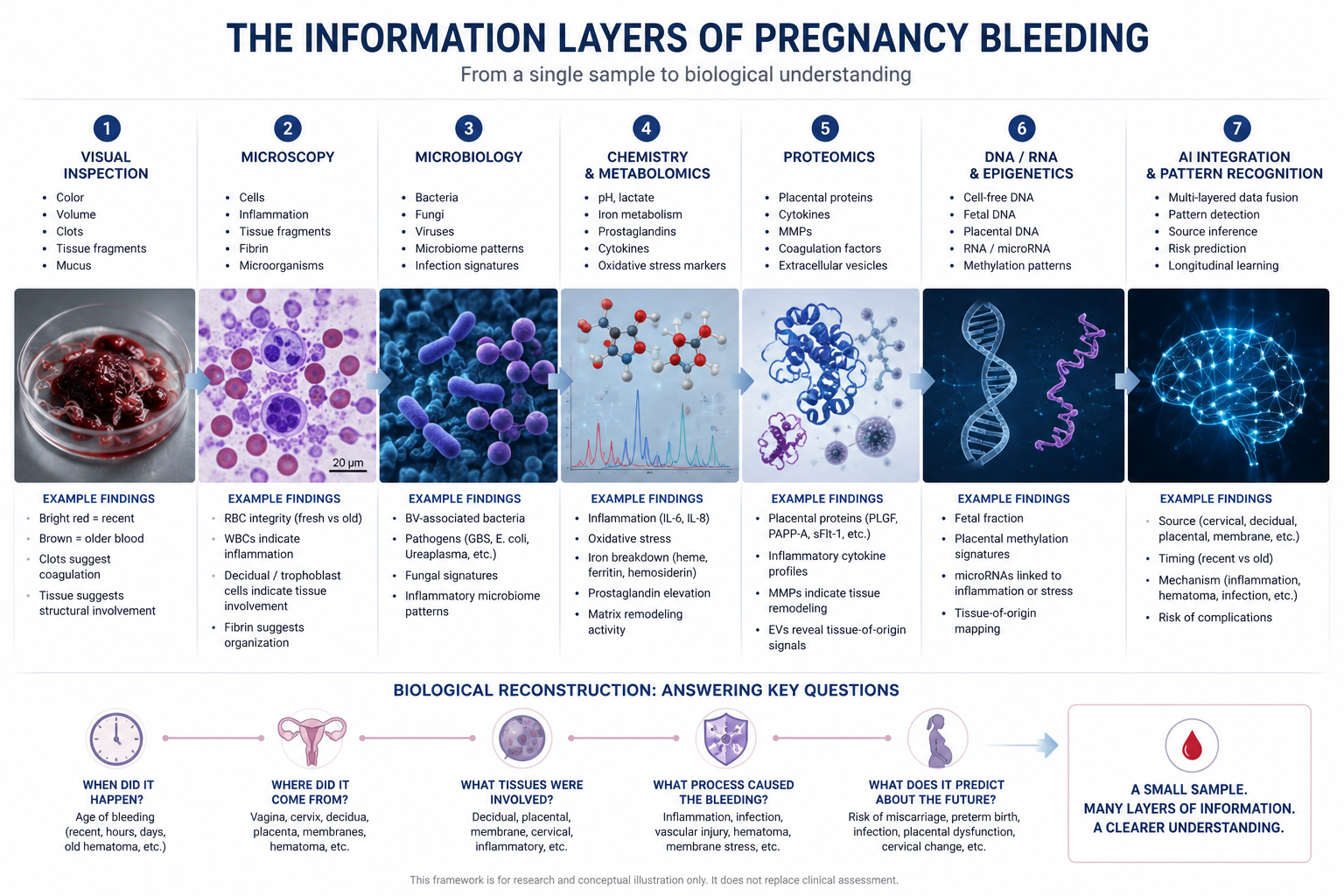
A forensic framework could organize pregnancy bleeding analysis into layers.
Layer 1: Visual Description
Color, volume, clots, mucus, tissue fragments.
Layer 2: Microscopy
Cells, debris, inflammation, bacteria, fibrin, tissue fragments.
Layer 3: Microbiology
Vaginal microbiome, infection signatures, ascending infection patterns.
Layer 4: Chemistry
pH, iron metabolism, oxidative stress, prostaglandins, coagulation and inflammatory mediators.
Layer 5: Proteomics
Placental proteins, immune proteins, matrix-remodeling enzymes and membrane-associated markers.
Layer 6: DNA and RNA
Maternal, fetal and placental signals, tissue-of-origin mapping and gene-expression patterns.
Layer 7: AI Interpretation
Pattern recognition across all layers to infer timing, source, mechanism and risk.
The goal would not be to replace clinical assessment.
The goal would be to add a new information layer: the biology of the bleeding itself.
10. Why Weeks 18–24 Matter
Weeks 18–24 are a sensitive period.
This is the zone where multiple biological and clinical pathways can overlap:
- miscarriage
- cervical insufficiency
- decidual hematoma
- subchorionic bleeding
- placental-interface disturbance
- infection
- membrane weakening
- early preterm labor pathways
- fetal viability transition
This makes the period difficult.
It also makes it scientifically important.
A bleeding sample from this window may contain signals from several interacting systems:
- maternal immune regulation
- placental attachment
- decidual remodeling
- cervical stability
- microbiome balance
- coagulation
- inflammation
- fetal-maternal interface biology
That is exactly why a forensic approach may be useful.
11. The Menstrual Blood Connection
There is a broader idea behind this framework.
Menstrual blood is also not just blood.
It contains endometrial cells, immune cells, inflammatory mediators, tissue fragments, hormones, microbiome signals and metabolites.
Unlike pregnancy bleeding, menstrual blood can be collected before pregnancy.
This raises an important research question:
Could menstrual blood act as a proxy model for understanding a woman’s reproductive inflammatory biology before pregnancy begins?
If so, menstrual blood analysis might one day help identify:
- inflammatory phenotypes
- abnormal tissue repair
- progesterone resistance
- endometrial immune imbalance
- coagulation tendencies
- microbiome disruption
- oxidative stress patterns
- endometriosis-associated inflammation
This does not mean menstrual blood can directly predict pregnancy bleeding today.
But it may become a useful model system.
The long-term question is whether pre-pregnancy reproductive fluid analysis could help identify biological patterns associated with miscarriage, hematoma, implantation problems or later pregnancy complications.
That is a major research direction.
12. The Central Hypothesis
The central hypothesis is simple:
Vaginal bleeding in mid-pregnancy is not a single symptom. It is a biological event that leaves a molecular trace.
If analyzed deeply, that trace may reveal:
- the age of the bleed
- the source of the bleed
- the tissues involved
- whether the process is fresh or chronic
- whether inflammation is present
- whether infection is involved
- whether the placenta or decidua is contributing
- whether fetal membranes are stressed
- whether fetal material is present
- whether future risk may be increased
This is not an argument that every woman should receive advanced multi-omics testing today.
It is an argument that the sample itself deserves scientific attention.
Conclusion: From Symptom to Signal
Pregnancy bleeding is usually approached from the outside.
How much bleeding?
What does ultrasound show?
What do maternal blood tests show?
What does the cervix look like?
What is the fetal status?
These questions matter.
But the bleeding itself may contain a hidden diagnostic archive.
A forensic approach asks a simple question:
What information is already present in the sample?
That question can be understood by a patient, a clinician, a pathologist, a molecular biologist, an engineer or an AI researcher.
It begins with common sense.
The blood came from somewhere.
It changed over time.
It passed through tissue.
It contains traces.
The next step is to learn how to read those traces.
Pregnancy bleeding should not only be seen as a symptom to record.
It may be a signal to decode.
References and Resource
1.Vaginal Bleeding After 20 Weeks of Gestation: Evaluation and Differential Diagnosis UpToDate
A clinical review of bleeding during the second half of pregnancy, covering placenta previa, placental abruption, cervical causes, infection, and diagnostic approaches. Useful as a reference for understanding how bleeding is currently evaluated in clinical practice.
2. Bleeding During Pregnancy American College of Obstetricians and Gynecologists (ACOG)
A patient-oriented but evidence-based overview of bleeding during pregnancy, including common causes and clinical considerations. Provides a broad framework for understanding why bleeding occurs and how it is interpreted.
3. Placental Biology and Pathology Nature Reviews Disease Primers
A comprehensive scientific review of placental structure, maternal-fetal interactions, inflammation, vascular remodeling, and placental dysfunction. Relevant for understanding how bleeding may reflect events occurring at the maternal-fetal interface.
4. Cell-Free DNA Analysis for Noninvasive Examination of Trisomy New England Journal of Medicine (NEJM)
One of the landmark papers demonstrating that fetal and placental DNA can be detected in maternal circulation. Provides a foundation for the concept that biological fluids may contain tissue-specific information that can be analyzed noninvasively.
5. Menstrual Blood: A Review on Diagnostic and Therapeutic Potential Frontiers in Reproductive Health
A review discussing menstrual blood as a source of cells, biomarkers, inflammatory signals, and molecular information. Particularly relevant to the article's hypothesis that reproductive bleeding may represent an underutilized biological dataset.