
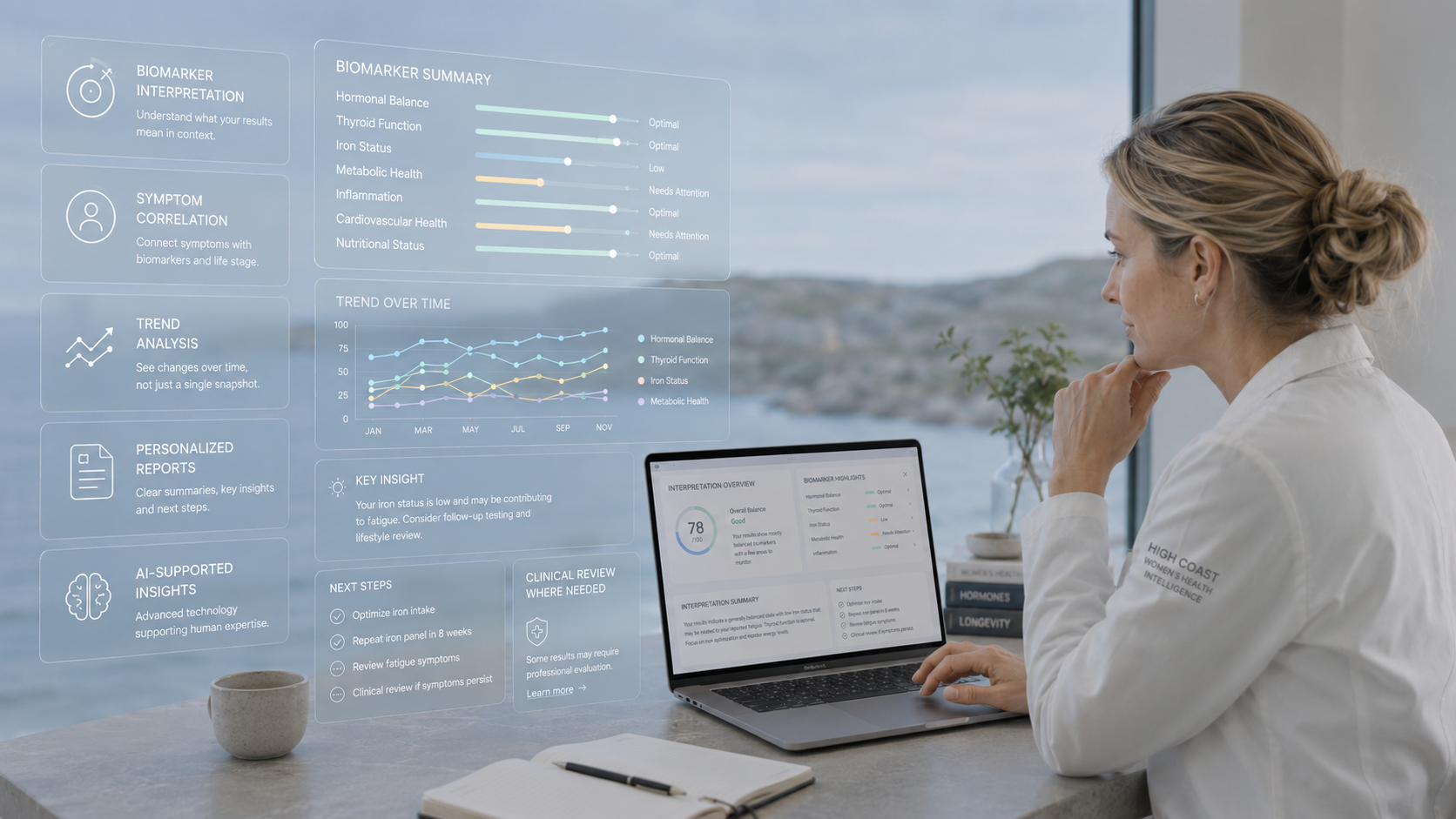
Interpretation
Turning biomarkers, symptoms and trends into clinically relevant insight
Diagnostics become useful when results are interpreted in context.
A biomarker value may show one part of the picture. A symptom may show another. A trend over time may reveal something that a single test cannot. Life stage, cycle timing, fertility history, pregnancy status, menopause transition, medication use and clinical background can all change how results should be understood.
High Coast Women’s Health Intelligence approaches interpretation as the bridge between testing and decision-making.
The purpose is not simply to report numbers.
The purpose is to ask:
What does this result mean?
What does it mean in this woman’s context?
Is it stable or changing?
Does it match the symptoms?
Is it clinically important?
What should be followed?
What needs human clinical review?
What decision can this information support?
Interpretation is where diagnostics become women’s health intelligence.

Why interpretation matters
Many women receive laboratory results without enough explanation.
Some results are marked normal or abnormal, but the clinical meaning may still be unclear. Some values fall inside reference intervals but may still be relevant when symptoms, life stage or trends are considered. Other values may appear concerning but are explainable through timing, medication, pregnancy stage, fertility treatment or known physiology.
The challenge is not only to measure.
The challenge is to interpret responsibly.
A structured interpretation model considers:
- biomarkers
- symptoms
- trends
- life stage
- menstrual cycle timing
- pregnancy status
- fertility or IVF history
- menopause status
- medication and hormone use
- medical history
- clinical risk factors
- whether review or escalation is needed
This helps avoid both overinterpretation and underinterpretation.
Biomarker interpretation
Biomarker interpretation connects test results to biological and clinical meaning.
A biomarker may be:
- clearly normal
- clearly abnormal
- borderline
- changing over time
- normal in the laboratory range but relevant in context
- abnormal but explainable by timing or treatment
- uncertain and requiring repeat testing
- important enough to require clinical review
In women’s health, biomarker interpretation often depends on context.
A hormone marker may depend on cycle phase.
A thyroid marker may matter differently during fertility planning or pregnancy.
A metabolic marker may become more important during menopause transition.
An inflammation marker may need to be interpreted alongside symptoms, infection risk, autoimmune history or tissue-related conditions.
A fertility marker may need age, ultrasound findings and reproductive history.
The question is not only whether a result is inside a reference interval.
The question is what the result means for the woman’s actual health question.
Symptom correlation
Symptoms are essential to interpretation.
Fatigue, bleeding changes, pelvic pain, cycle-related symptoms, mood changes, hot flashes, sleep disturbance, weight change, fertility difficulty, pregnancy symptoms and cognitive symptoms may all change the meaning of diagnostic data.
Symptom correlation means connecting what a woman experiences with measurable biological signals and timing.
This does not mean every symptom has a simple biomarker explanation.
Many symptoms are multifactorial. Some are not explained by standard testing. Some require clinical examination, imaging or specialist review. Some are influenced by sleep, stress, medications, inflammation, thyroid function, iron status, metabolic health, pregnancy stage or menopause transition.
A structured symptom correlation model asks:
When did the symptom begin?
Is it cyclical?
Is it related to pregnancy, postpartum recovery or menopause transition?
Is it worsening or improving?
Does it match biomarker changes?
Does it suggest a need for clinical review?
Symptoms become more useful when they are organized into patterns.
Trend analysis
A single test result is a snapshot.
A trend shows change.
Trend analysis may be more informative than one isolated measurement, especially in areas such as pregnancy monitoring, thyroid follow-up, metabolic prevention, menopause transition, inflammation, fertility treatment and long-term health programs.
Trend analysis may show whether a marker is:
- stable
- improving
- worsening
- fluctuating
- responding to intervention
- changing with cycle phase
- changing with pregnancy stage
- changing after medication or hormone therapy
- changing during perimenopause or postmenopause
This is important because many biological changes develop gradually.
Metabolic risk may increase over years.
Thyroid patterns may shift over time.
Inflammation may fluctuate.
Pregnancy biomarkers may need timing-based interpretation.
Menopause-related metabolic changes may become visible through repeated measurement.
Trend analysis asks:
What is changing, and does the change matter?
Personalized reports
A diagnostic report should do more than list values.
A personalized report should help the woman understand what was measured, why it matters and what the results may suggest in context.
A strong report should include:
- the purpose of the test or panel
- key findings
- relevant normal results
- borderline or abnormal results
- symptom context
- life-stage context
- trends where available
- what remains uncertain
- what may need follow-up
- when clinical review may be needed
- possible next steps
The goal is clarity.
A personalized report should not create unnecessary alarm. It should not make diagnostic claims beyond the evidence. It should not present AI interpretation as medical certainty.
It should help transform health data into understandable, responsible insight.
AI-supported insights
AI-supported interpretation can help organize complex health information.
Women’s health data may include laboratory results, symptoms, cycle history, pregnancy timelines, IVF history, ultrasound findings, menopause symptoms, metabolic markers, medications, previous reports and repeated tests over time.
AI may support:
- summarizing biomarkers
- identifying trends
- correlating symptoms and timing
- organizing life-stage context
- preparing personalized reports
- highlighting missing information
- prioritizing findings that may need review
- supporting clinical consultation preparation
But AI-supported insight is not the same as diagnosis.
AI should not replace clinical judgment, emergency care, specialist evaluation or medical treatment decisions.
Its role is to support structure, pattern recognition and communication.
The safest use of AI is not to make medicine automatic, but to make complex information clearer.
Clinical review where needed
Interpretation must include safety boundaries.
Some findings should not be handled through self-guided interpretation alone. They require clinical review, diagnosis, treatment decisions or urgent assessment.
Clinical review may be needed with:
- clearly abnormal blood results
- suspected thyroid disease
- anemia or severe iron deficiency
- diabetes-range glucose markers
- high cardiovascular risk markers
- significant inflammation
- abnormal liver or kidney markers
- pregnancy-related concerns
- heavy or unexplained bleeding
- bleeding after menopause
- severe pelvic pain
- recurrent pregnancy loss
- fertility concerns requiring specialist assessment
- severe or rapidly worsening symptoms
- unclear results that may require diagnosis or treatment
A responsible interpretation platform should help identify when information can be followed — and when medical care should take over.
Reference intervals and individual context
Reference intervals are useful, but they are not the whole story.
A laboratory reference interval describes where values commonly fall in a population. It does not always answer whether a result is optimal, relevant, changing, expected for a life stage or meaningful for a specific clinical question.
For example:
- a value may be within range but trending in an unfavorable direction
- a hormone marker may be normal but measured at the wrong cycle time
- a pregnancy marker may require gestational-age context
- a thyroid marker may need different attention during fertility planning or pregnancy
- a metabolic marker may be more important in a woman with family history or menopause transition
- an inflammation marker may be nonspecific without symptom context
Interpretation must therefore combine reference intervals with individual context.
This is where health intelligence becomes different from simple lab reporting.
From interpretation to action
Interpretation should lead somewhere.
A result may lead to reassurance.
A trend may lead to repeat testing.
A symptom pattern may lead to clinical review.
A metabolic marker may lead to prevention planning.
A fertility result may lead to specialist discussion.
A pregnancy symptom may require urgent assessment.
A menopause panel may support treatment discussion or cardiovascular prevention.
A longevity marker may support follow-up over time.
High Coast Women’s Health Intelligence moves interpretation through a structured pathway:
results → context → meaning → priority → guidance → follow-up → review where needed
This prevents diagnostics from becoming a dead end.
The question is always:
What decision can this support?
Interpretation across women’s health areas
Interpretation is a shared layer across the entire women’s health platform.
In hormone health, interpretation connects endocrine markers with symptoms, cycle timing, thyroid function, metabolism and life stage.
In fertility and IVF, interpretation connects ovarian reserve, ovulation, uterine context, treatment history and early pregnancy signals.
In pregnancy intelligence, interpretation connects symptoms, bleeding episodes, biomarkers, ultrasound timing, IVF history and escalation pathways.
In menopause and postmenopause, interpretation connects symptoms, hormonal transition, metabolic risk, cardiovascular prevention, bone health and HRT education.
In women’s longevity, interpretation connects biomarkers, inflammation, metabolism, vascular health, cognitive health, body composition and long-term prevention.
The same principle applies across all areas:
Data must be understood in context.
The core principle
Interpretation is the difference between having information and understanding what it means.
More data is not always better.
More testing is not always useful.
More dashboards do not automatically create better health decisions.
The value comes from structured interpretation.
High Coast Women’s Health Intelligence connects biomarkers, symptoms, trends, life stage, AI-supported insight and clinical safety into a responsible interpretation model.
The core principle is simple:
Turn results into meaning. Turn meaning into priorities. Turn priorities into safer, clearer next steps.