Women’s Panels
Targeted testing for fertility, hormones, menopause and longevity
Women’s health testing becomes more useful when it is organized around real clinical questions.
A single biomarker may provide one piece of information. A panel can provide a more structured view of a biological system, a life stage or a health concern. But a panel is only valuable when the included markers are relevant, interpretable and connected to a decision.
High Coast Women’s Health Intelligence uses women’s panels to organize diagnostics around the major questions in women’s health:
What is changing?
What should be measured?
What does this mean in context?
What should be followed over time?
What needs clinical review?
What can support prevention or planning?
The purpose is not to offer large test packages without direction.
The purpose is to create targeted diagnostic frameworks for fertility, hormone health, menopause, postmenopause, energy, fatigue and women’s longevity.

Why structured panels matter
Women’s health symptoms often overlap.
Fatigue may involve iron status, thyroid function, sleep, inflammation, metabolic health, pregnancy, perimenopause or medication effects.
Irregular cycles may involve ovulation, thyroid function, ovarian reserve, stress physiology, PCOS-related patterns, perimenopause or other gynecological causes.
Menopause symptoms may overlap with thyroid dysfunction, anemia, sleep disruption, metabolic change or mood conditions.
Fertility challenges may involve ovarian reserve, ovulation, thyroid function, inflammation, uterine factors, partner factors or previous reproductive history.
A structured panel helps organize testing so that markers are not selected randomly.
A good panel should answer:
- What question is this panel designed for?
- Which biological systems are relevant?
- What symptoms or life stage does it support?
- What markers are included?
- What are the limitations?
- What results may need follow-up?
- When is clinical review needed?
This is how panels become part of women’s health intelligence.
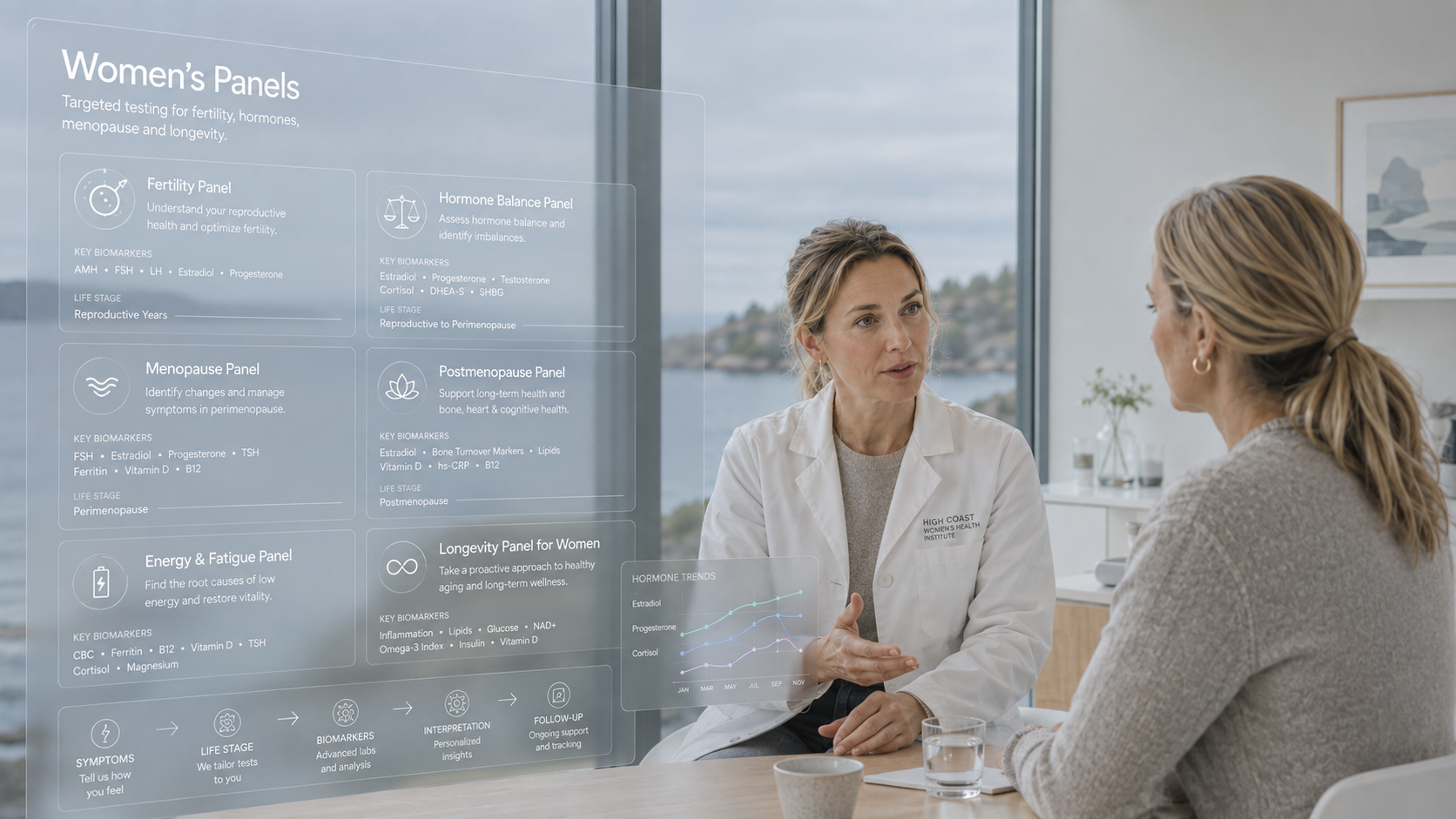
Fertility panel
A fertility panel supports women who are planning pregnancy, preparing for IVF, evaluating cycle patterns or trying to understand previous reproductive difficulty.
It may include markers related to ovarian reserve, ovulation, thyroid function, metabolic health, inflammation and micronutrient status, depending on the clinical question.
The purpose is not to predict pregnancy with certainty. No panel can do that.
The purpose is to clarify relevant biological signals before or during fertility planning.
A fertility panel may help structure questions such as:
- Is ovarian reserve relevant to planning?
- Is ovulation likely occurring?
- Is thyroid function appropriate for fertility planning?
- Are metabolic markers relevant?
- Is iron, vitamin D, folate or B12 status important?
- Is there a history suggesting the need for specialist review?
- Should results be interpreted in relation to previous IVF response or pregnancy loss?
Fertility panels should always be interpreted with age, cycle timing, reproductive history, ultrasound findings and partner factors where relevant.
Hormone balance panel
A hormone balance panel may be relevant when symptoms suggest endocrine involvement.
This may include cycle-related symptoms, irregular periods, suspected ovulation problems, androgen-related symptoms, perimenopausal changes, fatigue or symptoms that appear to follow a hormonal pattern.
The phrase “hormone balance” should be used carefully.
Women’s hormone biology is dynamic. Estrogen, progesterone, LH, FSH, androgens and other markers vary across the menstrual cycle, fertility treatment, pregnancy, perimenopause and menopause. A hormone value without timing may be misleading.
A hormone balance panel may help evaluate:
- cycle-phase patterns
- ovulation and luteal-phase context
- estrogen and progesterone dynamics
- androgen-related signals
- thyroid interaction
- perimenopausal transition
- medication or hormone exposure
- symptom timing
The goal is not to find a perfect hormone number.
The goal is to understand endocrine patterns in context.
Menopause panel
A menopause panel supports women in the perimenopausal or menopausal transition.
Menopause is often discussed through symptoms, but the transition can also involve metabolic, cardiovascular, thyroid, inflammatory, sleep and body-composition changes.
A menopause panel may include hormonal markers where relevant, but it should not rely only on estrogen or FSH. In many women, symptoms, age, menstrual history and clinical context are more useful than one hormone value alone.
A menopause panel may help assess:
- transition stage
- symptom context
- thyroid overlap
- metabolic markers
- lipid and cardiovascular risk
- iron status where bleeding is relevant
- inflammation context
- vitamin D and bone-health context
- whether clinical review or HRT discussion may be appropriate
The purpose is to support informed interpretation during a major biological transition.
Postmenopause panel
Postmenopause is a long-term prevention stage.
After menopause, the clinical focus often shifts toward cardiovascular prevention, metabolic health, bone health, body composition, cognitive health, urogenital health and healthy aging.
A postmenopause panel may include markers related to:
- glucose regulation
- lipid profile and ApoB where relevant
- blood pressure and cardiovascular risk
- thyroid function
- liver and kidney function
- inflammation markers where relevant
- vitamin D and bone-health context
- blood count and micronutrient status
- metabolic and body-composition risk
The purpose is not only to detect disease.
The purpose is to identify risk patterns early, support prevention and guide follow-up over time.
Postmenopausal bleeding, significant symptoms or abnormal results should always be reviewed through appropriate clinical pathways.
Energy and fatigue panel
Fatigue is common, but it is not one diagnosis.
Energy problems may involve iron deficiency, thyroid dysfunction, inflammation, glucose regulation, sleep disturbance, stress physiology, perimenopause, pregnancy, postpartum recovery, medication effects, nutritional deficiency, chronic disease or mental health conditions.
An energy and fatigue panel should therefore be interpreted carefully.
It may include markers related to:
- blood count
- iron and ferritin
- thyroid function
- vitamin B12 and folate
- vitamin D where relevant
- glucose regulation
- inflammation
- liver and kidney function
- metabolic markers
- pregnancy status where relevant
The purpose is to identify possible biological contributors, not to claim that all fatigue can be explained by laboratory testing.
A fatigue panel should support clearer next steps, including clinical review where symptoms are severe, persistent or unexplained.
Longevity panel for women
A longevity panel for women should be grounded in prevention and healthspan — not anti-ageing marketing.
The focus is to understand biological systems that influence long-term function, resilience and risk.
A women’s longevity panel may include markers related to:
- metabolic health
- cardiovascular risk
- inflammation
- thyroid function
- liver and kidney function
- micronutrient status
- bone-health context
- body composition
- menopause status
- biological age markers where scientifically appropriate
The purpose is not to promise longer life.
The purpose is to identify measurable patterns that may support prevention, follow-up and long-term health planning.
Women’s longevity testing should be interpreted in relation to life stage, reproductive history, menopause status, family history, symptoms, function and clinical risk.
How panels are interpreted
A panel is not a diagnosis.
A panel is a structured measurement tool.
The interpretation depends on:
- why the panel was selected
- symptoms
- life stage
- cycle phase or pregnancy status where relevant
- medication and hormone use
- previous results
- medical history
- family history
- known diagnoses
- clinical risk factors
- whether follow-up or specialist review is needed
High Coast Women’s Health Intelligence interprets panels through a pathway:
question → panel selection → measurement → context → interpretation → report → follow-up
This helps make the difference between isolated testing and structured women’s health intelligence.
What panels can and cannot do
Women’s panels can help identify patterns, support prevention and prepare better clinical conversations.
They can help clarify:
- possible contributors to symptoms
- metabolic and cardiovascular risk
- hormone-related patterns
- thyroid context
- micronutrient deficiencies
- fertility planning signals
- menopause transition markers
- trends over time
But panels have limits.
They cannot guarantee fertility.
They cannot diagnose every condition.
They cannot explain every symptom.
They cannot replace imaging, physical examination or specialist care.
They cannot replace urgent assessment when symptoms are concerning.
A responsible panel framework must clearly separate screening, interpretation, prevention support and medical diagnosis.
AI-supported panel reports
AI-supported interpretation can help make panel results easier to understand.
It may support:
- biomarker summaries
- trend comparisons
- symptom correlation
- life-stage context
- identification of findings that may need review
- structured reports
- follow-up planning
- preparation for clinical consultation
But AI-supported reports should remain medically careful.
They should explain uncertainty, avoid overdiagnosis and identify when human clinical review is needed.
The goal is clarity, not false certainty.
Clinical review where needed
Some panel results require professional review.
This may include:
- clearly abnormal thyroid markers
- anemia or severe iron deficiency
- diabetes-range glucose markers
- high cardiovascular risk markers
- significant inflammation
- abnormal liver or kidney markers
- abnormal pregnancy-related findings
- unexplained bleeding
- postmenopausal bleeding
- severe or persistent symptoms
- fertility concerns requiring specialist assessment
- unclear results requiring diagnosis or treatment
Health panels become safer when escalation is built into the model.
The right panel should not only show numbers.
It should help decide what happens next.
The core principle
Women’s panels are useful when they are targeted, interpretable and connected to meaningful follow-up.
Not every woman needs the same panel.
Not every symptom needs extensive testing.
Not every marker should be overinterpreted.
Not every abnormal result explains the whole picture.
High Coast Women’s Health Intelligence uses women’s panels to connect biomarkers, symptoms, life stage and prevention into structured interpretation.
The core principle is simple:
Choose the right panel for the right question. Interpret results in context. Follow what matters. Escalate when needed.