Applied Research
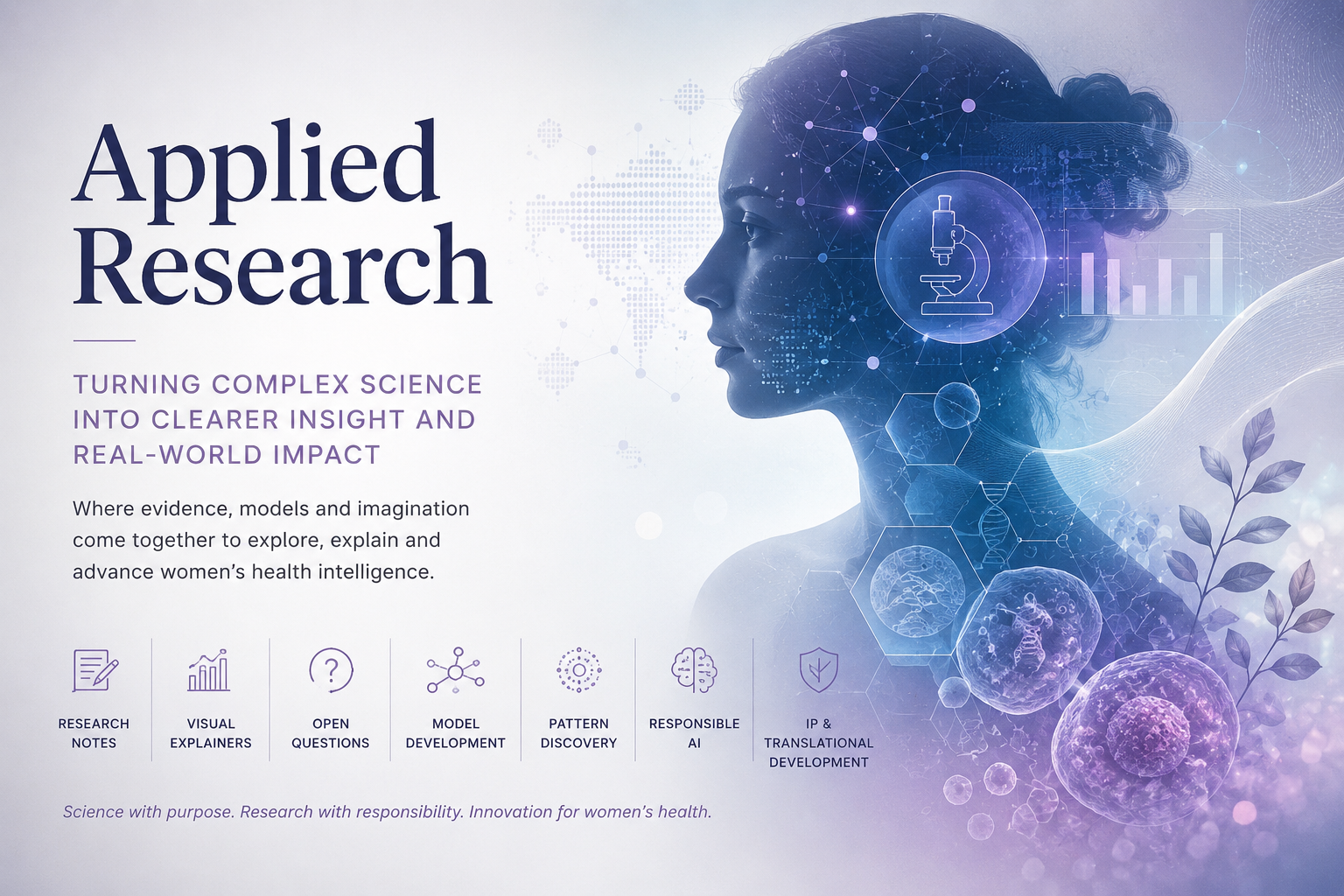
Applied Research is where High Coast Women’s Health Intelligence turns scientific questions into structured models, visual explanations, testable hypotheses and early translational development.
This section sits between evidence, imagination and implementation: it asks how research findings could become clearer frameworks, smarter interpretation tools and future clinical or laboratory concepts.
It is not limited to summarizing existing evidence. Instead, Applied Research explores patterns, mechanisms and open questions that may deserve deeper investigation. The goal is to make complex women’s health biology more understandable, more visual and more useful for future research, collaboration and innovation.
What this section includes
Research Notes
Research Notes are short reflections, early observations and structured scientific thoughts. They may begin with a question, a pattern, a clinical observation or a biological hypothesis that deserves more attention.
These notes are not final conclusions. They are a way to document emerging thinking, connect ideas across fields and identify areas where better research, better data or better models may be needed.
Visual Explainers
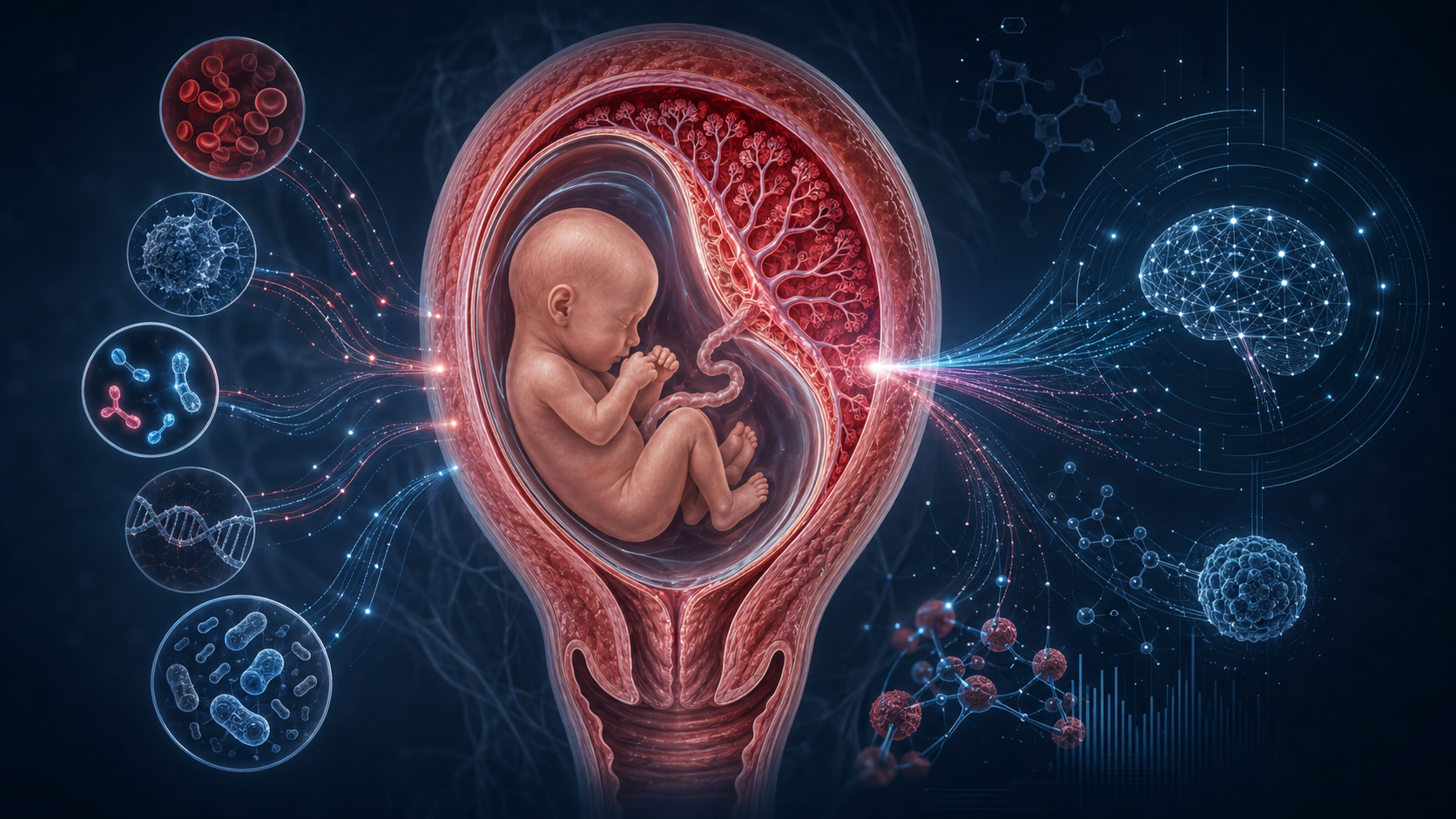
Visual Explainers use illustrations, diagrams and conceptual graphics to make complex biological systems easier to understand. Women’s health often involves interactions between hormones, inflammation, tissue remodeling, metabolism, pregnancy biology and aging, which can be difficult to grasp through text alone.
The purpose is not to oversimplify the science, but to make hidden biological processes more visible. A good visual model can help patients, researchers, clinicians and partners see relationships that are otherwise scattered across many separate studies.
Open Questions
Women are often given fragmented health information.
A laboratory result may be explained without symptom context. A symptom may be treated without understanding hormonal stage. A pregnancy complication may be monitored without clear educational explanation. Menopause may be described as a short-term symptom phase rather than a long-term biological transition.
Evidence Insights aims to create a more structured bridge between research and real health understanding.
We ask:
What is known?
What is uncertain?
What can be measured?
What can be followed over time?
What patterns may matter?
What should be studied further?
Model Development
Model Development is where biological ideas are organized into structured frameworks. These models may describe how symptoms, biomarkers, tissue changes, hormones, inflammation, microbiome signals or imaging findings could fit together.
The models are not presented as proven clinical tools. They are early conceptual structures that may help generate hypotheses, guide research design, support data collection and make complex systems easier to investigate.
Pattern Discovery
Pattern Discovery explores recurring signals across symptoms, biomarkers, reproductive history, bleeding patterns, inflammation, metabolic changes and health outcomes. Many important insights begin as patterns that are noticed before they are fully explained.
This section looks for relationships that may be clinically or scientifically meaningful, while remaining careful about uncertainty. A pattern is not the same as proof, but it can be the beginning of a useful research question.
Responsible AI
Responsible AI explores how artificial intelligence can support interpretation in women’s health while remaining transparent, cautious and clinically responsible. AI may help organize complex data, detect patterns and generate structured interpretations, but it must not replace scientific validation or clinical judgment.
This section focuses on explainability, uncertainty, bias, safety and the difference between research models and clinical decision-making. The aim is to develop AI-supported interpretation in a way that is useful, but not overconfident.
IP & Translational Development
IP & Translational Development covers early-stage invention capture, provisional IP work and the pathway from research concept to validation, partnership and future application. It is where selected research ideas are organized into more structured development platforms.
This does not mean that the concepts are finished products. It means that High Coast is identifying areas where research, laboratory work, data modeling, clinical collaboration and partner development may eventually lead to practical tools.
Development stage
Applied Research is not clinical advice and does not present finished diagnostic or treatment products.
It is a development space for ideas that may later be tested through research collaborations, laboratory work, data analysis and clinical validation.
The purpose is to show how High Coast Women’s Health Intelligence thinks, organizes evidence and builds research directions. It is a bridge between scientific curiosity and future translational development.