
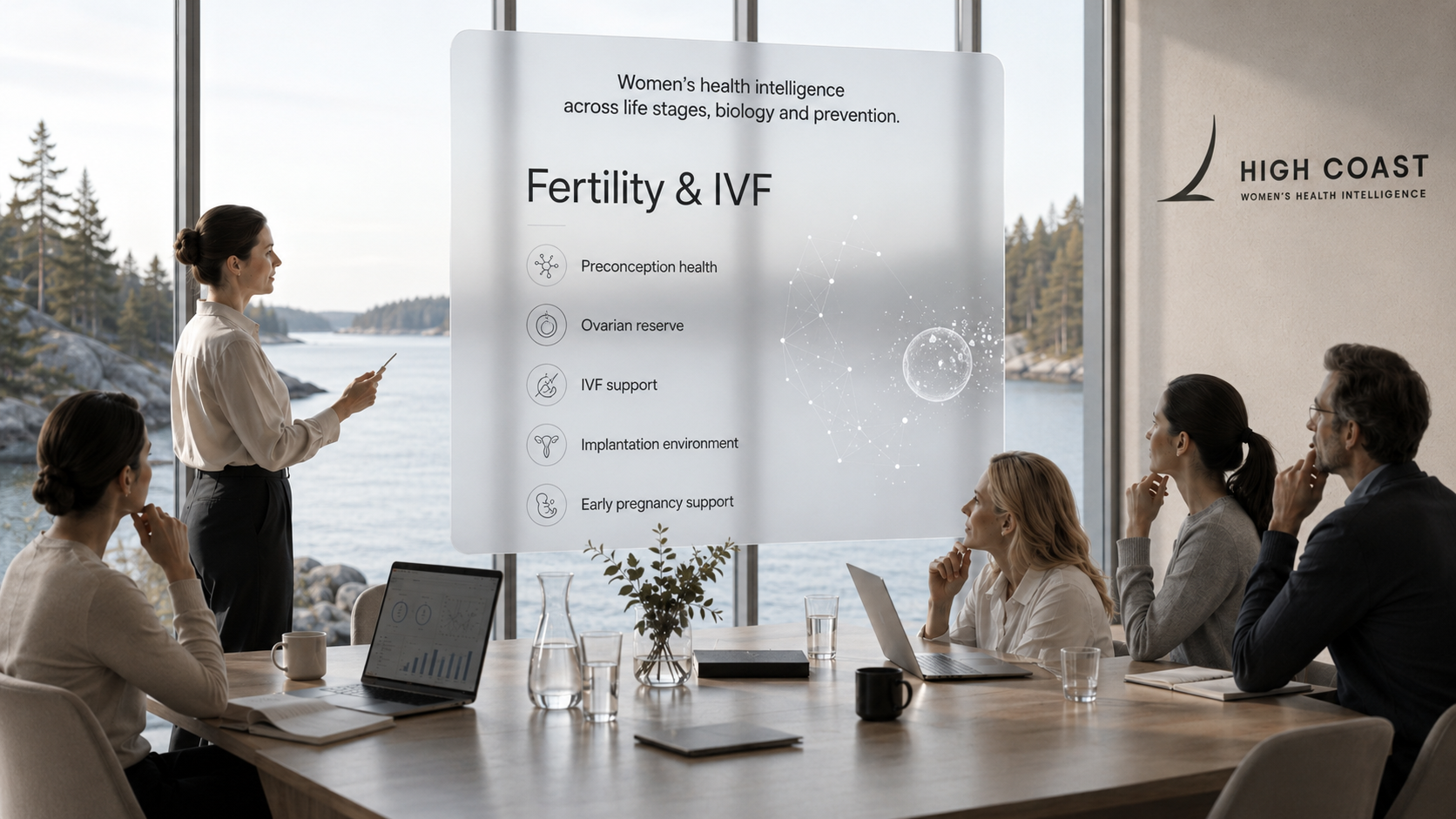
Fertility & IVF
Supporting preconception, implantation and early reproductive health
Fertility is often discussed as a narrow question of ovarian reserve, ovulation or IVF success rates. These factors are important, but they do not describe the full reproductive system.
Pregnancy begins through a sequence of biological events: follicle development, ovulation, fertilization, embryo development, endometrial preparation, implantation, early placental signaling and maternal adaptation. Each step is influenced by hormones, metabolism, inflammation, thyroid function, uterine environment, age, previous reproductive history and clinical context.
High Coast Women’s Health Intelligence approaches fertility and IVF as a connected biological process.
The goal is not to promise pregnancy or simplify fertility into single markers. The goal is to support structured interpretation before conception, during fertility treatment and in the vulnerable transition into early pregnancy.
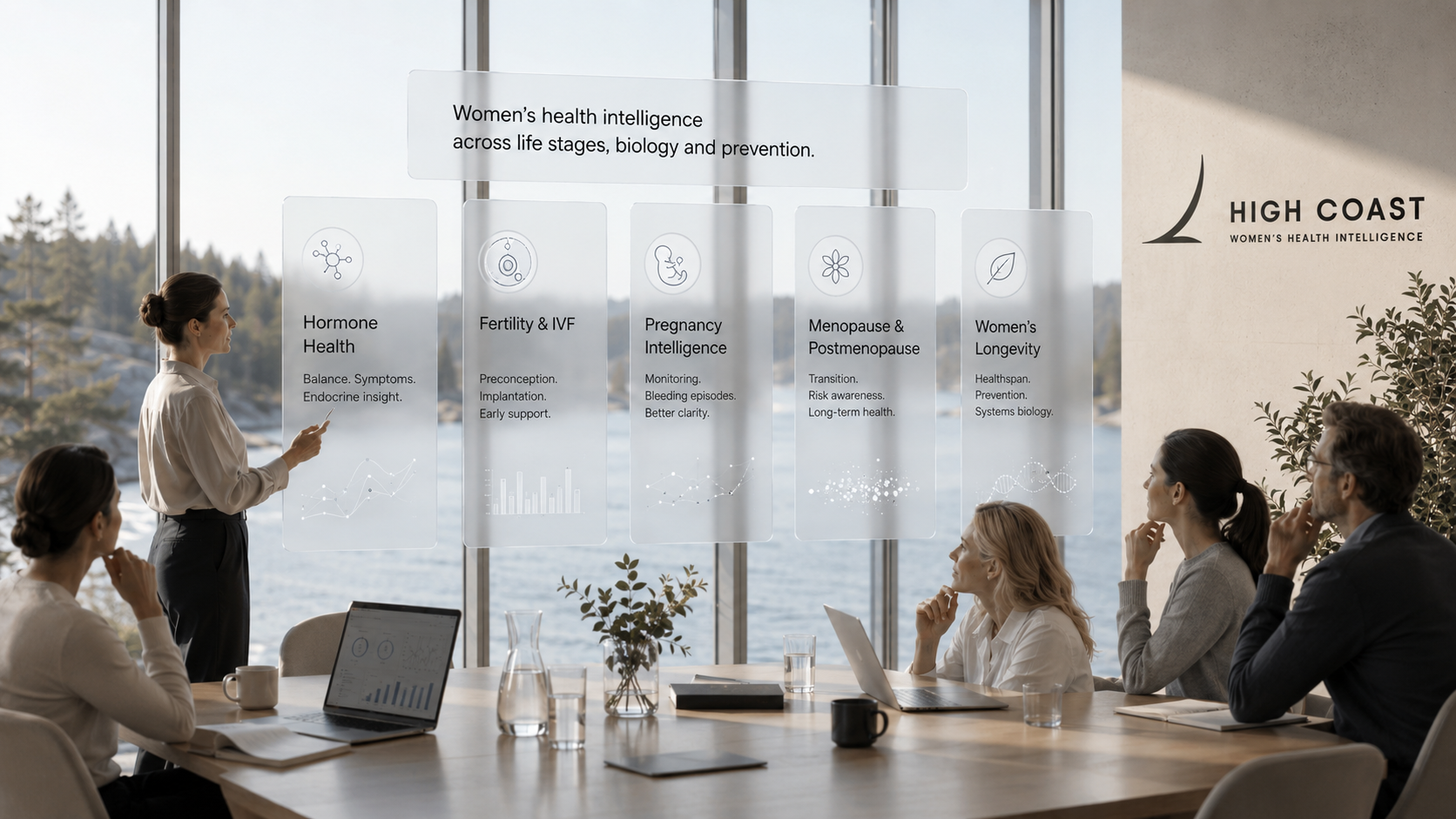
Fertility as a systems question
Fertility is not controlled by one organ or one laboratory value.
Ovarian reserve matters.
Ovulation matters.
Sperm factors matter.
Embryo development matters.
The uterus matters.
The endometrium matters.
Hormonal timing matters.
Metabolic and inflammatory context may matter.
Previous pregnancy and IVF history matter.
A fertility assessment becomes more useful when these layers are interpreted together.
This is especially important for women with irregular cycles, previous miscarriage, endometriosis, thyroid disease, metabolic risk, repeated IVF failure, unexplained infertility or complex reproductive history.
A systems approach asks:
What is measurable?
What is modifiable?
What is uncertain?
What should be followed?
What needs specialist review?
What decision can this information support?
Preconception health
Preconception health focuses on the biological conditions before pregnancy begins.
This may include reproductive history, cycle patterns, thyroid function, metabolic health, inflammation, micronutrient status, medication use, lifestyle factors, age-related risk and previous pregnancy outcomes.
The purpose is not to create anxiety before pregnancy. It is to identify factors that may be relevant before conception or IVF treatment begins.
A structured preconception approach may include:
- menstrual and ovulation history
- previous pregnancies and losses
- previous IVF or fertility treatment history
- thyroid and metabolic markers
- micronutrient status
- inflammation context
- medication and hormone exposure
- BMI, body composition and cardiovascular risk where relevant
- family history and known diagnoses
Preconception health is a window for prevention, preparation and clearer decision-making.
Ovarian reserve
Ovarian reserve testing can provide information about the expected quantity of remaining ovarian follicles and potential response to ovarian stimulation.
Common markers may include AMH, antral follicle count, FSH and estradiol, depending on clinical setting and timing.
However, ovarian reserve is not the same as fertility potential.
A low ovarian reserve marker may indicate fewer remaining follicles or a lower expected response to stimulation, but it does not alone determine whether pregnancy is possible. A normal marker does not guarantee conception or IVF success.
Ovarian reserve should be interpreted in relation to:
- age
- menstrual pattern
- ultrasound findings
- previous ovarian response
- fertility duration
- IVF history
- medical history
- treatment goals
- partner or sperm factors
The value of ovarian reserve testing is strongest when it helps guide planning, expectations and clinical strategy.
IVF support
IVF is not one event. It is a pathway.
It includes ovarian stimulation, egg retrieval, fertilization, embryo culture, embryo transfer, luteal support and early pregnancy monitoring. Each phase creates different questions and different forms of uncertainty.
High Coast Women’s Health Intelligence can support IVF through structured interpretation of:
- ovarian reserve and expected stimulation response
- previous IVF cycle outcomes
- hormone patterns
- embryo transfer timing
- luteal-phase support
- thyroid and metabolic context
- endometrial and uterine factors
- previous miscarriage or implantation failure
- symptom and blood test tracking after transfer
The aim is not to replace fertility clinics. The aim is to help women and professionals organize information, identify patterns and support clearer follow-up.
Implantation environment
Implantation depends on interaction between the embryo and the uterine environment.
The endometrium is not a passive surface. It is a hormonally responsive, immune-active and vascular tissue interface. Its readiness may be influenced by ovulation, progesterone response, estrogen exposure, inflammation, uterine anatomy, endometriosis, adenomyosis, metabolic factors and previous reproductive history.
Implantation difficulty may involve many possible causes, and in many cases uncertainty remains.
A structured implantation framework may consider:
- embryo factors
- endometrial timing
- luteal-phase progesterone context
- uterine anatomy and imaging findings
- endometriosis or adenomyosis suspicion
- inflammation and tissue-state factors
- bleeding patterns
- previous implantation failure
- previous miscarriage history
High Coast Women’s Health Intelligence is especially interested in how local tissue-state biology may influence implantation and early pregnancy vulnerability.
Early pregnancy support
The early weeks after conception or embryo transfer are biologically active and emotionally sensitive.
For many women, especially after IVF or previous miscarriage, early pregnancy involves uncertainty, repeated testing, symptom interpretation and concern about bleeding, pain or changing pregnancy signals.
Early pregnancy support may include structured interpretation of:
- pregnancy test progression
- hCG patterns where clinically relevant
- progesterone context where measured
- bleeding or spotting episodes
- pelvic pain or cramping
- ultrasound timing
- previous miscarriage history
- IVF treatment background
- symptoms and trigger events
The purpose is not to create excessive monitoring for everyone. The purpose is to provide structured follow-up where closer interpretation is clinically or emotionally meaningful.
Some symptoms or findings require urgent clinical assessment, and any early pregnancy monitoring framework must include clear escalation pathways.
Fertility markers and diagnostic context
Fertility diagnostics should be selected because they answer a relevant question.
Markers may include reproductive hormones, ovarian reserve markers, thyroid markers, metabolic markers, inflammation markers and micronutrients. Imaging may provide information about ovarian follicles, uterine anatomy, endometrial thickness, fibroids, polyps, adenomyosis, endometriosis suspicion or other structural factors.
But no test should be interpreted alone.
A fertility marker becomes useful when connected to:
- age
- symptoms
- cycle timing
- reproductive history
- ultrasound findings
- treatment plan
- previous response to treatment
- partner factors
- clinical goals
This is how fertility diagnostics become reproductive intelligence.
Fertility, inflammation and endometriosis
Inflammation and tissue-state biology may be relevant in some reproductive conditions, especially endometriosis, adenomyosis, chronic pelvic pain, recurrent implantation failure and some patterns of miscarriage risk.
Endometriosis is not only a pain condition. It may involve inflammatory activation, lesion persistence, altered hormone responsiveness, pelvic tissue changes and immune-vascular signaling.
In fertility and IVF, this may raise questions about:
- ovarian reserve
- egg retrieval outcomes
- pain and symptom patterns
- implantation environment
- endometrial receptivity
- local inflammation
- pregnancy vulnerability
- treatment timing
The evidence is complex, and not every fertility problem is inflammatory. However, in selected patients, reproductive outcomes may be better understood when local tissue biology is considered alongside standard fertility testing.
This is part of the broader High Coast model of tissue-state thinking.
AI-supported fertility interpretation
Fertility journeys often generate large amounts of fragmented information: cycle dates, hormone tests, ultrasound reports, IVF protocols, embryo results, symptoms, medication schedules, pregnancy tests and prior clinical notes.
AI-supported interpretation may help organize this information into clearer patterns.
It may support:
- timeline reconstruction
- cycle and treatment mapping
- comparison between IVF cycles
- symptom and biomarker correlation
- identification of missing context
- structured summaries for clinical discussion
- prioritization of findings that may need review
AI should not predict pregnancy with false certainty or replace fertility specialists.
Its role is to support structure, clarity and continuity.
When specialist review is needed
Fertility and IVF questions often require specialist evaluation.
Clinical review is especially important in cases of:
- infertility lasting longer than expected for age
- irregular or absent ovulation
- suspected endometriosis or adenomyosis
- recurrent pregnancy loss
- repeated implantation failure
- abnormal semen analysis
- abnormal uterine imaging
- thyroid disease
- significant metabolic risk
- severe pain or bleeding
- early pregnancy warning symptoms
- complex IVF history
A responsible fertility intelligence framework should help identify when a question belongs in specialist care, when further testing may be needed and when reassurance or structured follow-up may be appropriate.
From fertility data to reproductive intelligence
Fertility and IVF become easier to navigate when information is structured.
A fertility marker may guide planning.
An IVF history may reveal patterns.
A symptom timeline may provide context.
A pregnancy signal may require follow-up.
A tissue-state model may generate research hypotheses.
A clinical review may clarify next steps.
High Coast Women’s Health Intelligence moves fertility information through a structured pathway:
history → diagnostics → cycle context → interpretation → treatment support → early pregnancy follow-up → learning
The core principle is simple:
Fertility should not be reduced to one number, one embryo or one cycle. It should be understood as a connected reproductive system across time.