Health Areas
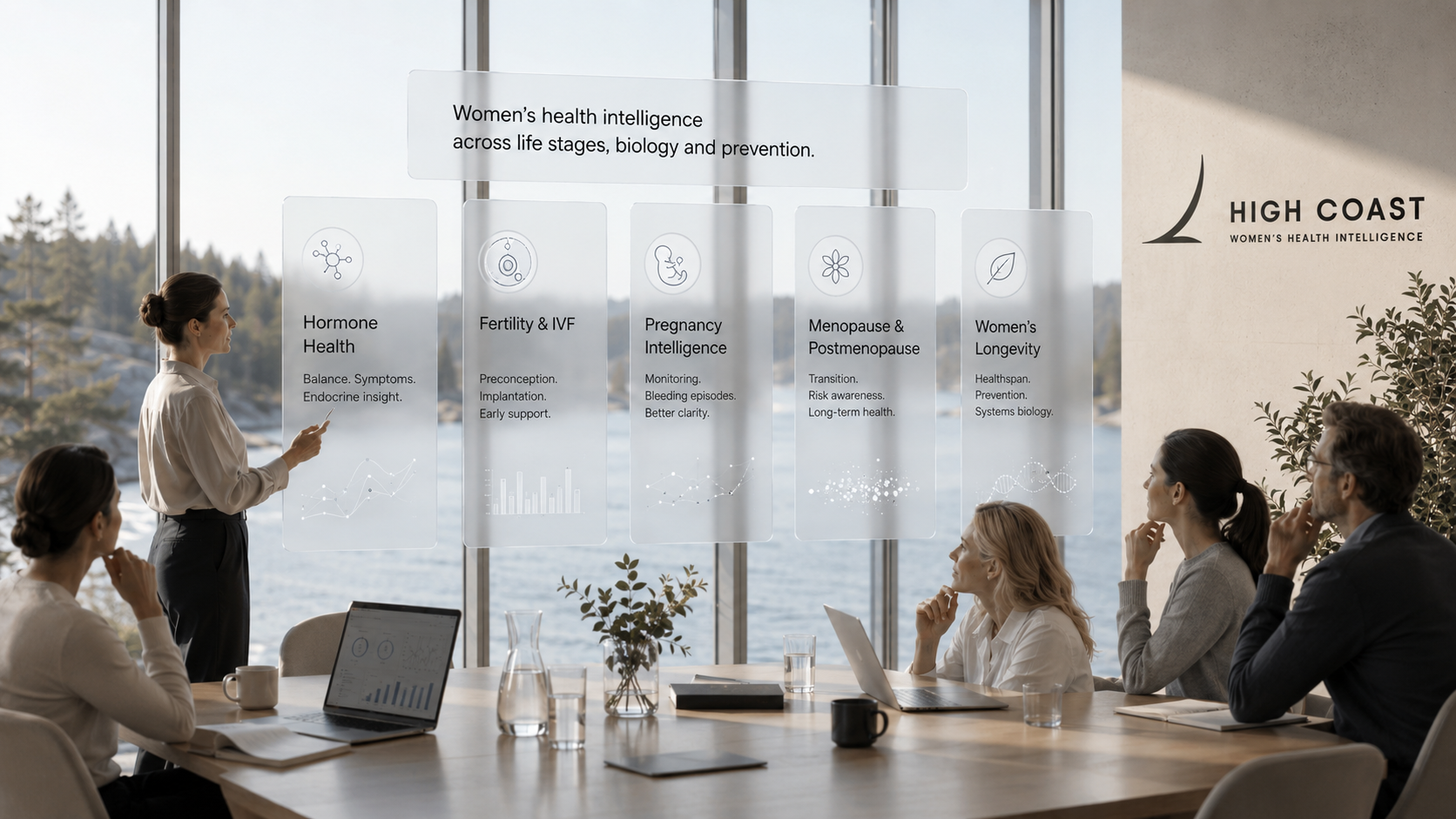
Women’s health intelligence across life stages, biology and prevention.
High Coast Women’s Health Intelligence is organized around the major biological systems and life stages that shape women’s health over time.
Our health areas connect symptoms, biomarkers, clinical context, prevention and research into structured understanding. The goal is not to treat each topic as isolated, but to understand how hormones, fertility, pregnancy, menopause, metabolism, inflammation and aging interact across the female life journey.
Hormone Health
Interpreting endocrine patterns behind symptoms, function and change
Hormones influence many areas of women’s health, including cycle function, fertility, sleep, energy, mood, metabolism, skin, inflammation and long-term health risk.
Hormonal symptoms are often complex because they may involve several systems at the same time, including estrogen, progesterone, thyroid function, cortisol, insulin sensitivity and inflammatory signaling.
Our hormone health framework focuses on:
- hormone balance
- cycle-related symptoms
- progesterone and estrogen
- thyroid interaction
- cortisol and stress
The purpose is to move from isolated symptoms toward a more structured understanding of endocrine patterns and biological context.
Fertility & IVF
Supporting preconception, implantation and early reproductive health
Fertility is influenced by more than reproductive organs alone. Hormones, ovarian reserve, thyroid function, inflammation, metabolism, immune signaling, age, previous pregnancy history and general health can all influence reproductive outcomes.
High Coast Women’s Health Intelligence approaches fertility and IVF through diagnostics, prevention, education and structured interpretation.
Our fertility and IVF framework focuses on:
- preconception health
- ovarian reserve
- IVF support
- implantation environment
- early pregnancy support
The purpose is to support better understanding before conception, during fertility treatment and in the earliest stages of pregnancy.
Pregnancy Intelligence
Monitoring pregnancy signals, bleeding episodes and risk patterns
Pregnancy Intelligence is our applied health intelligence area for pregnancy-related monitoring, education and research.
This area is especially relevant for women who need or want closer structured follow-up during pregnancy, including after IVF, previous miscarriage, bleeding episodes, hematoma, endometriosis, high concern or complex medical history.
Our pregnancy intelligence framework focuses on:
- pregnancy monitoring
- IVF and previous miscarriage support
- bleeding and hematoma monitoring
- placenta, inflammation and pregnancy tissue interface
- blood tests and symptom tracking
- AI-supported interpretation
The purpose is to connect symptoms, blood tests, ultrasound-related information, medical history and follow-up patterns into clearer pregnancy understanding.
We also use this area for applied research and visual education, while clearly separating established clinical knowledge from hypotheses and open research questions.
Menopause & Postmenopause
Understanding hormonal transition and long-term health risk
Perimenopause, menopause and postmenopause are major biological transitions. They affect more than reproductive hormones.
Changes in estrogen, progesterone and other physiological systems may influence sleep, mood, energy, metabolism, weight, cardiovascular risk, bone health, cognition, skin, inflammation and long-term quality of life.
Our menopause and postmenopause framework focuses on:
- perimenopause
- menopause symptoms
- postmenopausal health
- bone and cardiovascular health
- HRT education
The purpose is to understand hormonal transition as both a symptom phase and a long-term preventive health opportunity.
Women’s Longevity
Advancing healthspan through biomarkers, prevention and systems biology
Women’s longevity requires an understanding of female biology across time.
Hormonal transitions, inflammation, mitochondrial function, nitric oxide, vascular health, metabolic resilience, cognitive health, skin aging and biological age are all part of the long-term healthspan picture.
Our women’s longevity framework focuses on:
- biological age
- skin aging
- mitochondria
- nitric oxide
- inflammation
- cognitive health
The purpose is to support long-term health through diagnostics, prevention, biomarker interpretation and systems biology.
A Connected Model
Women’s health areas should not be understood as separate silos.
Hormone health can affect fertility. Fertility history can affect pregnancy monitoring. Pregnancy and postpartum health may reveal future metabolic or cardiovascular risk. Menopause changes long-term prevention needs. Longevity begins long before old age.
High Coast Women’s Health Intelligence connects these areas into one framework:
Symptoms
↓
Biomarkers
↓
Life stage
↓
Clinical and biological context
↓
Research-based interpretation
↓
Informed health decisions
Key Message
Women’s health changes across life, but the systems are connected.
High Coast Women’s Health Intelligence brings hormone health, fertility, pregnancy, menopause and longevity into one structured model for diagnostics, prevention, research and long-term health decisions.