
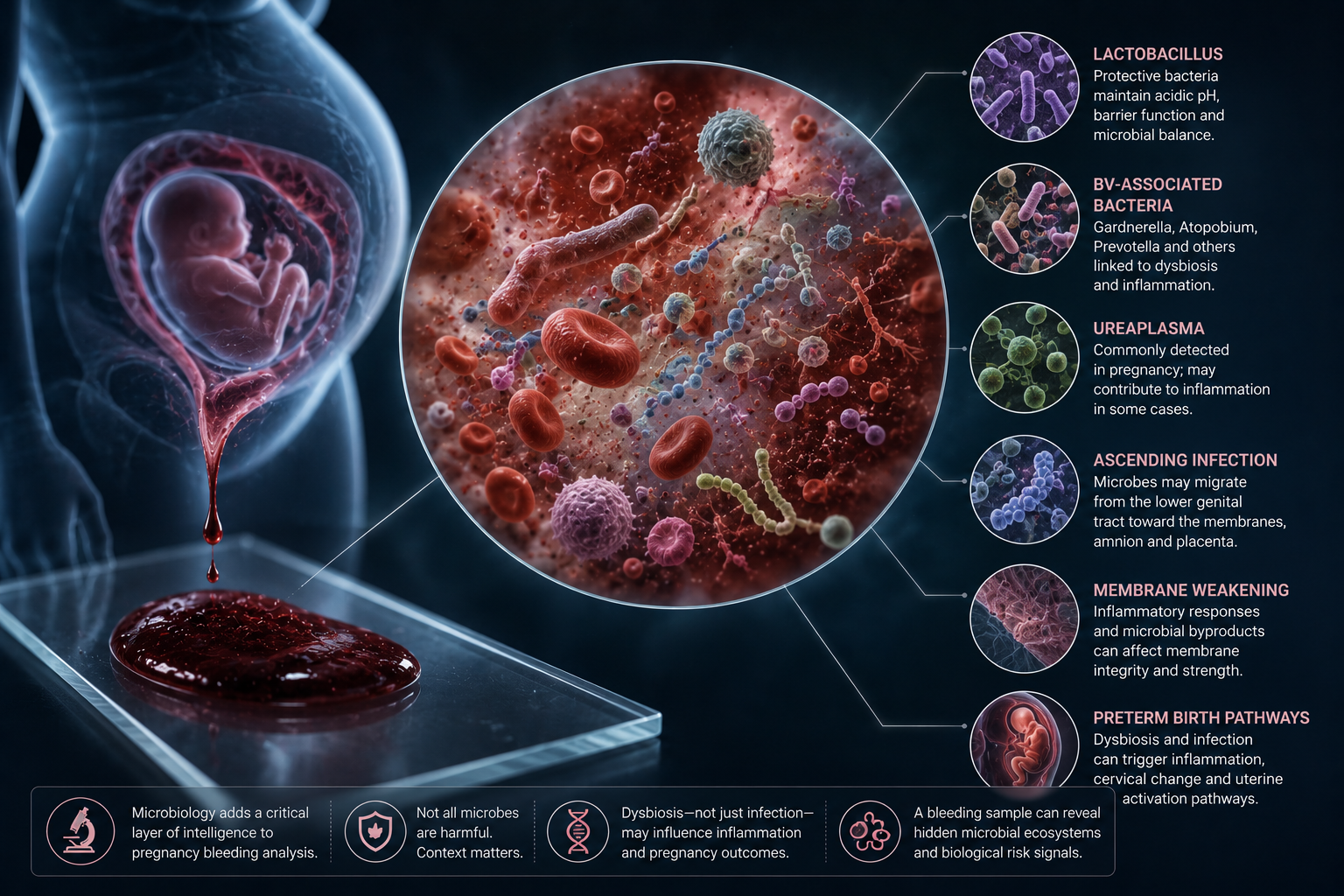
Can a bleeding sample reveal infection, dysbiosis or inflammatory microbiome patterns?
A woman presents with vaginal bleeding during pregnancy.
The blood is visible.
Under the microscope we may see red blood cells, inflammatory cells, fibrin and tissue fragments.
But another question remains:
What microorganisms are present?
For decades, infection was often viewed as a relatively simple concept.
Either an infection was present.
Or it was absent.
Modern microbiome research has challenged that view.
The reproductive tract contains entire microbial communities.
Some appear protective.
Some may be neutral.
Others may promote inflammation, membrane weakening, cervical change or pathways associated with preterm birth.
This raises an important forensic question:
Can pregnancy bleeding carry clues about the microbial environment in which it occurred?
This article explores that possibility.
The Forgotten Passengers in a Bleeding Sample
A bleeding sample is rarely sterile.
As blood exits the reproductive tract, it may interact with:
- vaginal secretions
- cervical mucus
- epithelial surfaces
- immune cells
- bacterial communities
- fungal communities
- microbial metabolites
This means that pregnancy bleeding may contain not only information about tissue and inflammation.
It may also contain information about the local microbiome.
In a forensic framework, microbiology becomes the third layer of evidence.
The Healthy Vaginal Microbiome
The human vagina is not normally sterile.
In many healthy women, the microbiome is dominated by Lactobacillus species.
Common examples include:
- Lactobacillus crispatus
- Lactobacillus jensenii
- Lactobacillus gasseri
- Lactobacillus iners
These bacteria are often considered protective.
They help maintain:
- acidic pH
- microbial stability
- pathogen resistance
- immune regulation
In simple terms, Lactobacillus species help create an environment that is generally hostile to many harmful organisms.
For this reason, the presence or absence of Lactobacillus dominance has become an important area of reproductive research.
What Is Dysbiosis?
Dysbiosis means disruption of a microbial ecosystem.
Instead of being dominated by protective organisms, the environment becomes more diverse or shifts toward organisms associated with inflammation.
This does not necessarily mean a woman has symptoms.
Nor does it automatically mean infection.
But it may alter the biological environment.
Possible consequences include:
- increased inflammation
- altered immune signaling
- cervical changes
- membrane stress
- altered tissue repair
- increased susceptibility to pathogens
Pregnancy researchers have become increasingly interested in whether dysbiosis contributes to adverse pregnancy outcomes.
Bacterial Vaginosis: More Than an Infection
One of the most studied forms of vaginal dysbiosis is bacterial vaginosis (BV).
BV is not simply the presence of a single organism.
Instead, it represents a shift away from Lactobacillus dominance toward a mixed microbial community.
Common BV-associated organisms include:
- Gardnerella vaginalis
- Atopobium vaginae
- Prevotella species
- Mobiluncus species
- Sneathia species
BV has been associated with:
- vaginal inflammation
- altered immune responses
- membrane weakening
- increased risk of preterm birth
- ascending microbial invasion
This does not mean BV causes every pregnancy complication.
But it illustrates how microbial communities may influence reproductive biology.
Ureaplasma: The Organism That Refuses to Fit the Rules
Few organisms have generated as much debate in obstetrics as Ureaplasma.
Common species include:
- Ureaplasma parvum
- Ureaplasma urealyticum
These organisms are frequently found in healthy women.
Yet they are also commonly identified in studies of:
- preterm birth
- chorioamnionitis
- membrane inflammation
- intra-amniotic infection
This creates a fascinating question.
Why do some women tolerate Ureaplasma without problems while others develop inflammatory complications?
The answer remains unclear.
But it highlights an important principle:
The biological context may matter as much as the organism itself.
Ascending Infection: A Key Hypothesis
One of the most important concepts in reproductive microbiology is ascending infection.
The theory is straightforward.
Microorganisms present in the lower reproductive tract may move upward toward:
- cervix
- membranes
- amniotic cavity
- placenta
Once there, they may trigger inflammation.
This inflammation may contribute to:
- membrane weakening
- cervical remodeling
- uterine activation
- preterm labor pathways
Not every bleeding event involves infection.
But understanding whether microbial signals suggest an ascending process could be highly informative.
Can Bleeding Reveal Membrane Stress?
The fetal membranes are not passive barriers.
They are biologically active tissues.
Inflammation can alter:
- collagen structure
- extracellular matrix
- immune signaling
- membrane strength
Over time, these changes may increase susceptibility to rupture.
Researchers have become interested in whether microbial communities influence these processes.
If a bleeding sample contains microbial signatures associated with membrane inflammation, it may provide clues about the biological environment surrounding the pregnancy.
The challenge is determining whether those signals are meaningful.
The Inflammation Connection
Microbes rarely act alone.
Much of their biological impact occurs through inflammation.
A microbiome profile may influence:
- cytokines
- chemokines
- prostaglandins
- matrix metalloproteinases
- immune cell recruitment
These inflammatory pathways are also involved in:
- cervical remodeling
- tissue repair
- membrane weakening
- uterine activation
This means the relationship between microbes and pregnancy bleeding may be indirect.
The organisms may not cause bleeding directly.
Instead, they may alter the environment in which bleeding occurs.
What Could We Look For in a Bleeding Sample?
A research-oriented microbiome analysis might examine:
Protective Organisms
- Lactobacillus abundance
- microbial stability
- community dominance patterns
Dysbiosis Markers
- Gardnerella
- Atopobium
- Prevotella
- Sneathia
Ureaplasma and Mycoplasma
- presence
- abundance
- inflammatory context
Potential Pathogens
- Group B Streptococcus
- E. coli
- Enterococcus
- Candida
- sexually transmitted organisms
Community Structure
- diversity
- dominance
- instability
- inflammatory signatures
The goal is not simply to detect microbes.
The goal is to understand ecosystems.
Beyond Culture: The DNA Revolution
Traditional microbiology relies heavily on culture.
Many organisms are difficult to culture.
Modern sequencing techniques allow researchers to identify microbial DNA directly.
This has transformed reproductive microbiology.
Instead of asking:
"What organism grows in the laboratory?"
We can ask:
"What organisms are present?"
This distinction is important because entire microbial communities may be relevant.
Not just individual pathogens.
The Forensic Framework
A microbiome-oriented forensic assessment could ask:
Who Is Present?
Which organisms are detected?
Who Dominates?
Is the ecosystem Lactobacillus-dominant or not?
Is There Dysbiosis?
Does the community resemble patterns associated with inflammation?
Is There Evidence of Ascending Risk?
Are organisms present that have been associated with membrane or placental inflammation?
What Is the Inflammatory Context?
Do microbial findings align with inflammatory signals?
How Does This Fit the Clinical Picture?
Do microbiome findings support other evidence from microscopy, chemistry or clinical assessment?
This is where microbiology becomes more than pathogen hunting.
It becomes ecosystem interpretation.
What Microbiology Cannot Tell Us
The presence of a microorganism does not prove causation.
A bacterium may be:
- harmless
- protective
- opportunistic
- inflammatory
- unrelated to the bleeding
This is one of the biggest challenges in microbiome science.
Finding an organism is easy.
Understanding its biological significance is much harder.
That is why microbiology must be interpreted together with:
- microscopy
- chemistry
- inflammation markers
- clinical findings
- pregnancy outcomes
The Central Question
The traditional question is:
"Is there an infection?"
The modern question may be:
"What kind of microbial ecosystem is present?"
Those are not the same question.
A woman may have no obvious infection and still possess a microbiome pattern that influences inflammation, tissue remodeling or pregnancy biology.
Understanding that distinction may be one of the most important developments in reproductive medicine.
Conclusion: The Third Layer of Evidence
Visual forensics asks:
What does the bleeding look like?
Microscopy asks:
What cells and tissues are present?
Microbiology asks:
What microbial ecosystem surrounds the event?
A bleeding sample may contain traces of:
- protective Lactobacillus communities
- dysbiosis-associated organisms
- Ureaplasma
- inflammatory microbiome patterns
- potential ascending infection pathways
These findings do not automatically explain the bleeding.
But they provide context.
And context is often where biological understanding begins.
In the framework of Pregnancy Bleeding Intelligence, the microbiome becomes the third layer of evidence.
Not because microbes explain everything.
But because every biological event occurs within an ecosystem.
And sometimes, the ecosystem leaves traces.
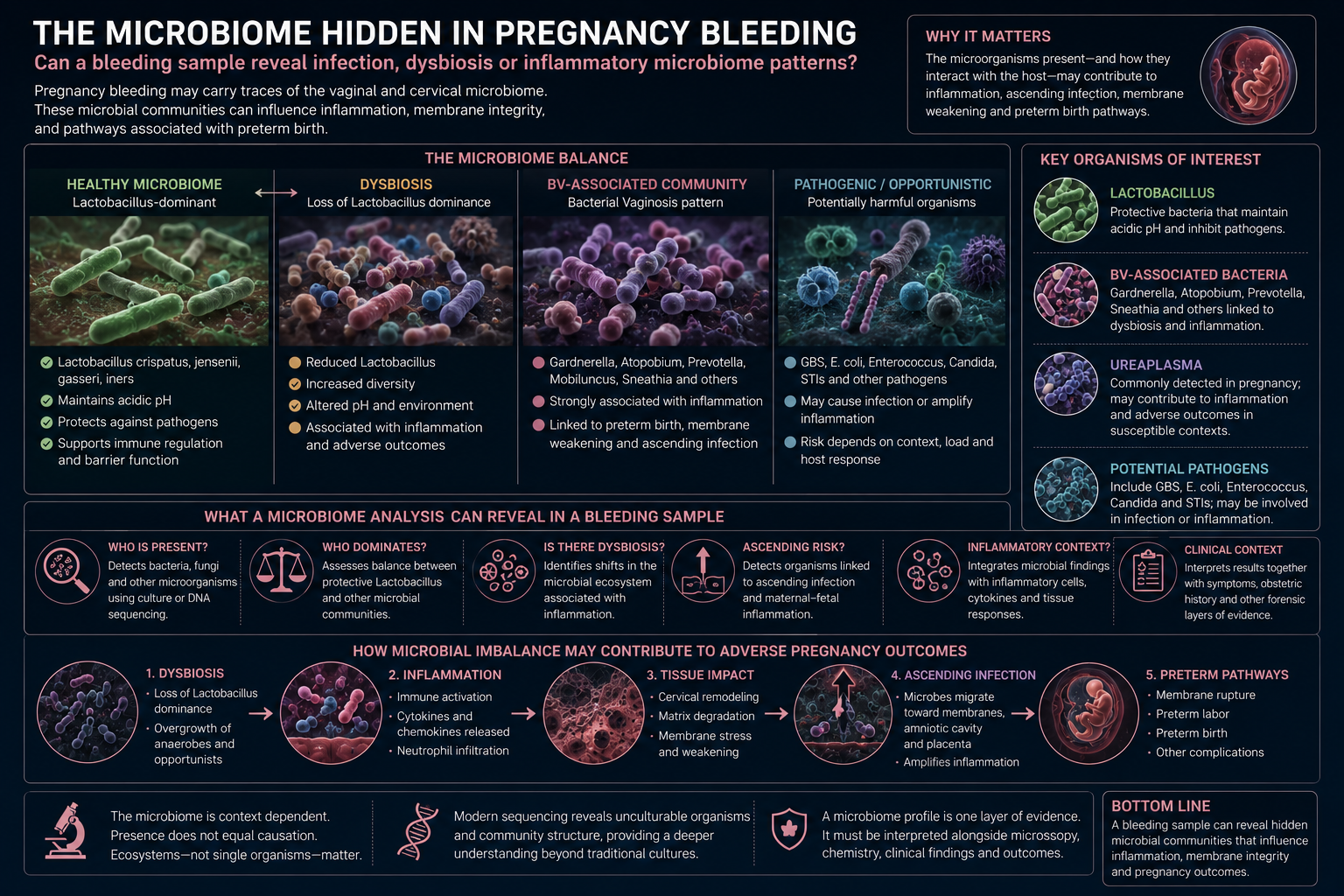
Figure 1. The Microbiome Hidden in Pregnancy Bleeding.
Conceptual framework illustrating how pregnancy bleeding may contain microbial information reflecting the vaginal and cervical microbiome. Potential findings include Lactobacillus-dominant communities, bacterial vaginosis-associated organisms, Ureaplasma species, inflammatory microbiome patterns and microbial signatures linked to membrane weakening, ascending infection and preterm birth pathways. This figure is a simulated educational illustration and is not derived from a real patient sample.
References and Resource
1. The Vaginal Microbiome and Preterm Birth Nature Medicine
A landmark review describing how different vaginal microbiome compositions may influence inflammation, membrane integrity and risk of preterm birth. One of the most important papers connecting microbial ecosystems to pregnancy outcomes.
2. The Vaginal Microbiota and Pregnancy Outcomes Nature Reviews Urology
A comprehensive review of Lactobacillus dominance, dysbiosis, bacterial vaginosis and their potential relationship with adverse pregnancy outcomes.
3. Ureaplasma Species and Preterm Birth Clinical Microbiology Reviews
A detailed review examining the controversial role of Ureaplasma in pregnancy, membrane inflammation, chorioamnionitis and preterm delivery.
4. Microbial Invasion of the Amniotic Cavity in Pregnancy American Journal of Obstetrics and Gynecology
Classic work describing ascending infection pathways and how microorganisms can migrate from the lower reproductive tract toward fetal membranes and the amniotic cavity.
5. The Human Vaginal Microbiome Proceedings of the National Academy of Sciences (PNAS)
One of the foundational papers demonstrating that vaginal microbial communities differ significantly between women and that Lactobacillus-dominant ecosystems are not universal.