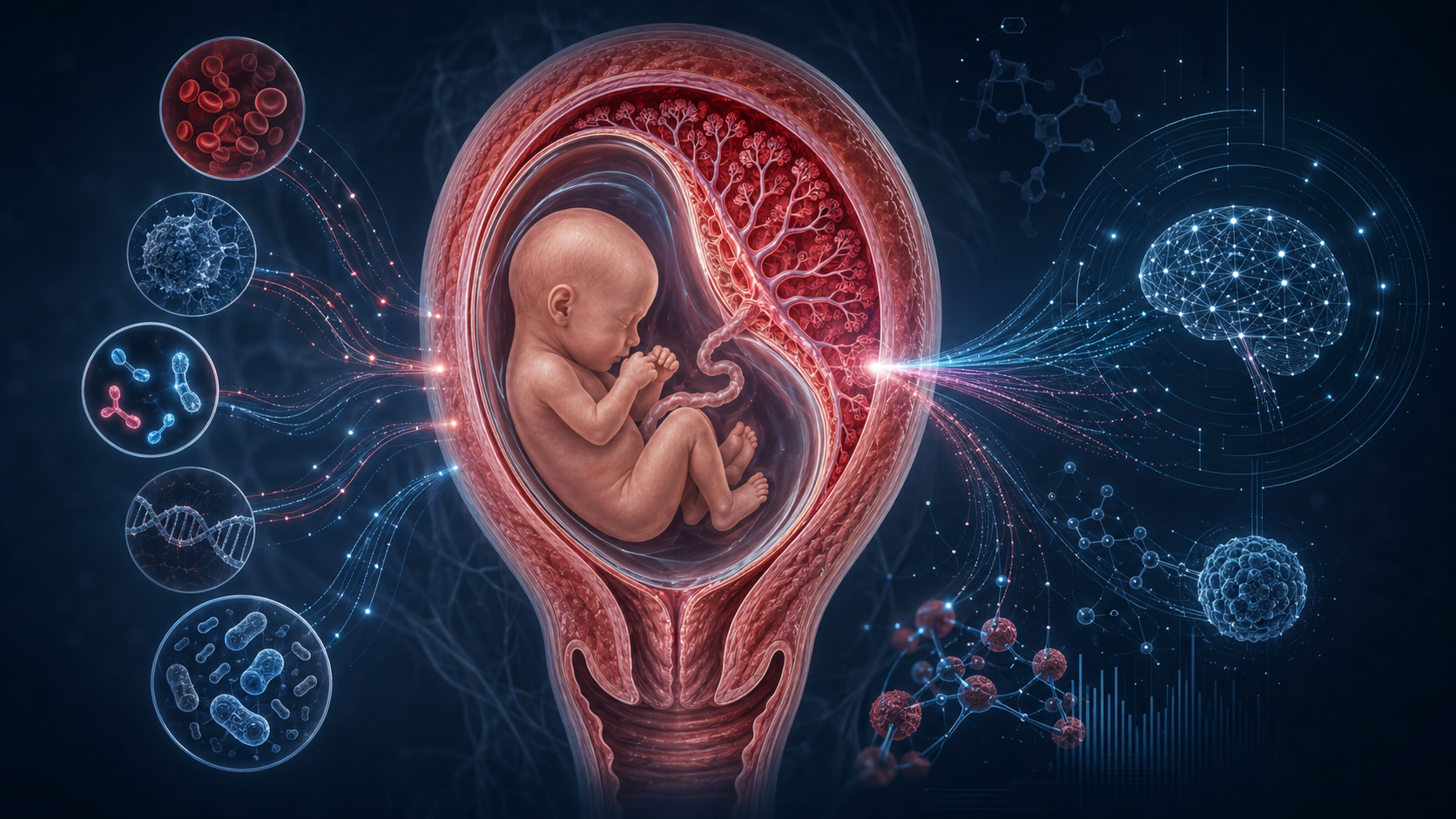
Can AI integrate hundreds of biological signals into a coherent interpretation?
Pregnancy bleeding is often described in simple terms.
Red or brown.
Light or heavy.
With or without clots.
Painful or painless.
Early or late.
These descriptions matter.
But they only capture a small part of the biological event.
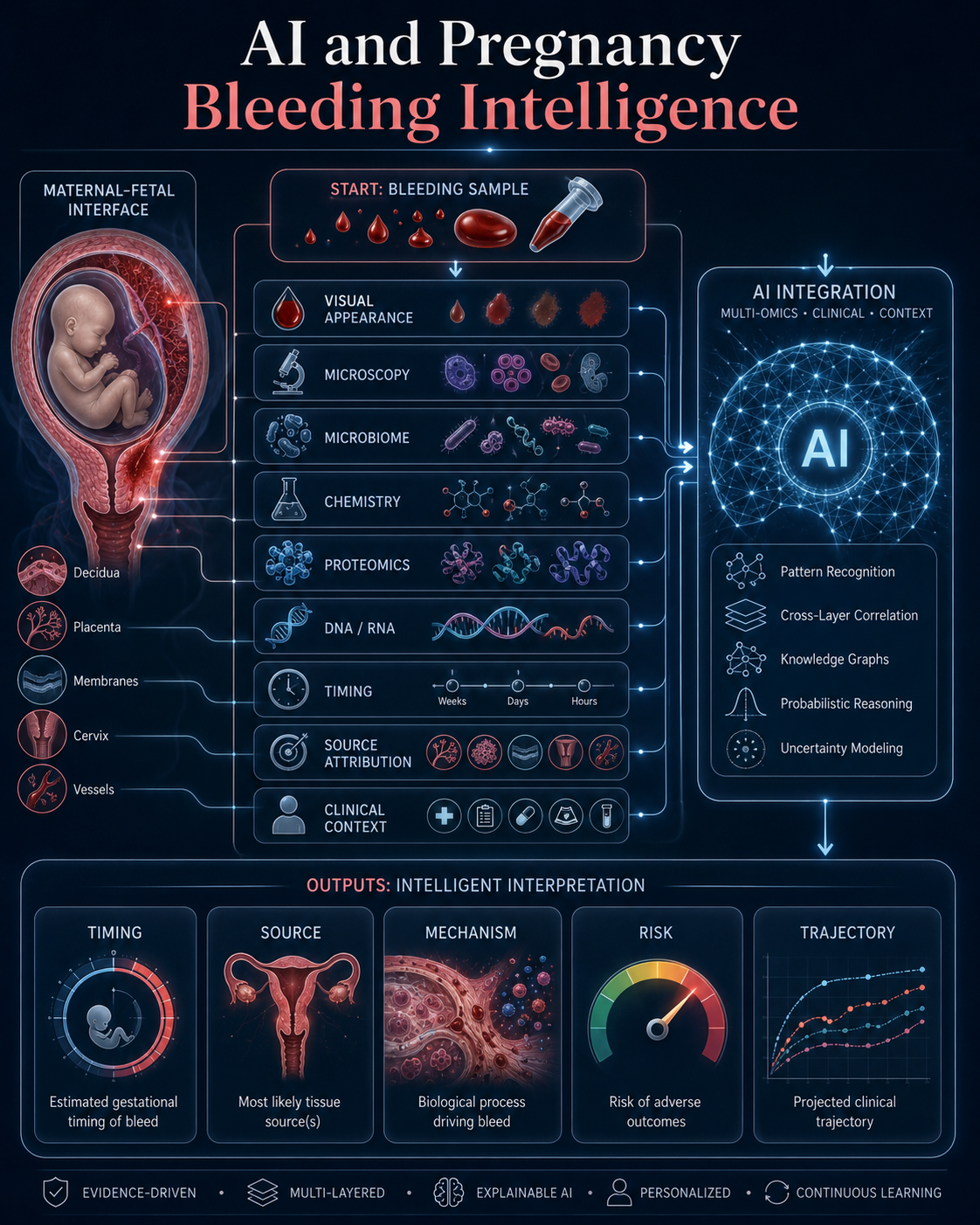
A bleeding sample may contain visual clues, cells, microbes, chemistry, proteins, DNA, RNA, tissue fragments and timing signals.
Each layer provides partial information.
The challenge is that no single layer tells the full story.
Visual appearance may suggest whether blood is fresh or old.
Microscopy may show inflammatory cells, macrophages or tissue fragments.
Microbiology may reveal dysbiosis or organisms linked to inflammation.
Chemistry may show oxidative stress, iron metabolism or prostaglandin activity.
Proteomics may reveal placental, decidual, inflammatory or matrix-remodeling proteins.
DNA and RNA may suggest tissue origin and biological activity.
Timing analysis may suggest whether the bleed is fresh, old, mixed or retained.
Source reconstruction may suggest whether the cervix, decidua, placenta or fetal membranes are involved.
But how can all these signals be interpreted together?
This is where artificial intelligence becomes interesting.
Not as a replacement for clinical judgment.
But as a way to integrate complex biological evidence.
The Problem: Too Many Signals for Simple Interpretation
Pregnancy bleeding is not one disease.
It is a visible endpoint of many possible biological processes.
Possible contributors include:
- cervical bleeding
- decidual bleeding
- hematoma drainage
- placental-interface disruption
- membrane inflammation
- infection
- dysbiosis
- vascular stress
- coagulation
- tissue remodeling
- immune activation
- old retained blood
- mixed old and fresh bleeding
Each process may produce overlapping signs.
Brown blood may suggest older bleeding, but not the source.
Macrophages may suggest cleanup, but not the cause.
Inflammatory proteins may suggest immune activation, but not whether infection is present.
Placental DNA may suggest placental contribution, but not necessarily pathology.
A human expert can reason through these patterns.
But as the number of variables grows, interpretation becomes difficult.
This is the type of problem where AI may become useful.
Pattern Recognition
AI is fundamentally strong at pattern recognition.
It can learn from large datasets where many variables are measured at the same time.
In pregnancy bleeding, an AI model could potentially analyze:
- color
- clot morphology
- bleeding pattern over time
- microscopy images
- cell populations
- microbiome profiles
- cytokines
- chemokines
- iron metabolism markers
- oxidative stress markers
- prostaglandins
- placental proteins
- decidual proteins
- MMPs
- fetal DNA
- placental methylation
- RNA signatures
- microRNAs
- ultrasound findings
- gestational age
- clinical outcomes
The goal would not be to find one perfect marker.
The goal would be to recognize biological patterns.
For example, the model might learn that a specific combination of old brown blood, degraded red cells, macrophages, hemosiderin, fibrin, decidual proteins and low fresh-blood signal often corresponds to old hematoma drainage.
Another pattern might suggest cervical-source bleeding.
Another might suggest placental-interface involvement.
Another might suggest inflammatory membrane stress.
This is the core idea of Pregnancy Bleeding Intelligence:
not one signal, but converging evidence.
Multi-Omics Integration
Modern biomedical research increasingly uses multi-omics.
This means combining several biological data layers, such as:
- genomics
- epigenomics
- transcriptomics
- proteomics
- metabolomics
- microbiomics
- imaging
- clinical data
Pregnancy bleeding is a natural multi-omics problem.
The sample may contain DNA, RNA, proteins, metabolites, microbes and cells.
Each layer captures a different aspect of the event.
Visual data
Shows what the bleeding looks like.
Microscopy
Shows cells, tissue fragments and blood degradation.
Microbiome data
Shows microbial communities and dysbiosis.
Chemistry
Shows metabolic activity, inflammation and oxidative stress.
Proteomics
Shows tissue pathways and functional biology.
DNA/RNA
Shows tissue origin and gene activity.
Clinical data
Shows gestational age, symptoms, ultrasound, course and outcome.
AI could help combine these layers into a single probabilistic interpretation.
The output should not be a simplistic diagnosis.
It should be a structured biological interpretation.
What Would AI Try to Predict?
An AI system for pregnancy bleeding could potentially predict several things.
1. Timing
Is the bleeding likely fresh, old, mixed, repeated or retained?
2. Source
Is the likely source cervix, decidua, placenta, membranes, vagina or mixed?
3. Mechanism
Is the dominant process inflammatory, vascular, infectious, hematoma-related, membrane-related or cervical-remodeling-related?
4. Risk
Is the pattern associated with higher risk of miscarriage, preterm birth, membrane rupture, placental complications or recurrent bleeding?
5. Trajectory
Is the pattern more consistent with resolving bleeding, persistent instability or escalating biological stress?
This is where AI becomes more than classification.
It becomes biological reconstruction.
Risk Prediction
Risk prediction is one of the most tempting uses of AI.
Could a bleeding sample help estimate future risk?
Possible outcomes of interest include:
- continued pregnancy without complication
- recurrent bleeding
- hematoma persistence
- pregnancy loss
- preterm labor
- preterm premature rupture of membranes
- placental abruption
- fetal growth restriction
- infection-related complications
Risk prediction would require large datasets.
Each case would need:
- standardized sample collection
- visual classification
- microscopy
- microbiology
- chemistry
- proteomics
- DNA/RNA
- clinical findings
- ultrasound findings
- pregnancy outcome
Only then could models learn which biological patterns matter.
This is not simple.
But it is scientifically realistic.
Pregnancy bleeding produces a sample.
That sample contains biological data.
If enough samples are linked to outcomes, prediction becomes possible.
Explainable AI
In medicine, black-box AI is not enough.
A model should not simply say:
“High risk.”
It should explain why.
Explainable AI is critical.
A useful system might say:
Increased risk pattern driven by:
- old blood degradation markers
- high inflammatory cytokines
- decidual protein signature
- macrophage and hemosiderin signal
- elevated MMP-related remodeling markers
- microbiome dysbiosis pattern
Or:
Low-risk pattern driven by:
- fresh low-volume bleeding
- cervical mucus signal
- limited inflammation
- no placental DNA enrichment
- Lactobacillus-dominant microbiome
- no strong membrane-remodeling signal
The goal is not only prediction.
The goal is interpretation.
For clinicians and researchers, the explanation may be as important as the risk score.
AI Should Generate Hypotheses, Not Replace Thinking
Pregnancy bleeding is complex.
AI should not be treated as an oracle.
Instead, it should be used as a hypothesis generator.
It can suggest:
- likely tissue source
- dominant biological pathway
- uncertainty level
- missing information
- possible next tests
- patterns similar to previous cases
- features driving the interpretation
For example:
Pattern suggests old decidual-interface bleeding, but membrane involvement remains uncertain. Additional markers of membrane stress would improve confidence.
That is useful.
It is not pretending to know everything.
It is organizing uncertainty.
Clinical Implementation
For AI to become clinically useful, the system must be practical.
A future workflow might look like this:
Step 1: Sample collection
Bleeding sample is collected in a standardized way.
Step 2: Visual classification
Color, clots, mucus, fragments and volume are recorded.
Step 3: Rapid tests
Basic pH, blood degradation markers, inflammatory markers and infection screening are performed.
Step 4: Microscopy
Automated image analysis identifies cells, debris, fibrin and tissue fragments.
Step 5: Molecular testing
Selected proteomic, microbiome or DNA/RNA markers are measured when needed.
Step 6: AI integration
The model integrates all available data.
Step 7: Report
The output provides:
- likely timing
- likely source
- dominant mechanism
- risk pattern
- uncertainty level
- recommended interpretation pathway
This does not have to begin with full multi-omics for every patient.
It could start with tiered testing.
Tiered AI Model
A realistic system could have three levels.
Tier 1: Basic
Uses:
- visual appearance
- gestational age
- symptoms
- bleeding pattern
- basic clinical data
Output:
- low-information interpretation
- need for further evaluation
- preliminary pattern classification
Tier 2: Intermediate
Adds:
- microscopy
- pH
- inflammatory markers
- microbiology
- basic blood degradation markers
Output:
- improved source and timing estimate
- infection/inflammation pattern
- hematoma-like pattern
Tier 3: Advanced
Adds:
- proteomics
- DNA/RNA
- methylation
- microRNA
- metabolomics
- longitudinal data
Output:
- tissue-of-origin mapping
- multi-omics pathway analysis
- risk prediction
- precision interpretation
This tiered model makes the concept more realistic.
Not every setting needs the most advanced system.
The Dataset Problem
The biggest obstacle is not imagination.
It is data.
To train useful AI, we need high-quality datasets.
These datasets must include:
- enough patients
- standardized sampling
- clear gestational age
- bleeding descriptions
- microscopy
- microbiome data
- chemistry
- proteomics
- DNA/RNA
- imaging
- follow-up
- pregnancy outcomes
Without good data, AI becomes speculation.
With good data, it becomes a pattern-recognition tool.
This is why Pregnancy Bleeding Intelligence should begin as a research framework before becoming a clinical product.
Bias and Safety
AI models can fail if trained on biased or incomplete datasets.
Important questions include:
- Were different populations included?
- Were gestational ages balanced?
- Were mild and severe cases included?
- Were outcomes accurately recorded?
- Were samples collected consistently?
- Were confounders handled?
- Does the model work across hospitals and countries?
- Does it explain uncertainty?
Pregnancy care is high-stakes.
A model must be safe, validated and transparent.
AI should support decision-making.
It should not replace clinical responsibility.
The Role of the Clinician
AI may integrate data, but humans still provide context.
A clinician understands:
- the patient
- symptoms
- examination
- ultrasound
- fetal status
- medical history
- social context
- urgency
- uncertainty
The future is not AI versus clinician.
The future is clinician plus better biological signal integration.
AI may help read the sample.
The clinician reads the patient.
Both matter.
The Long-Term Vision
The long-term vision is bigger than pregnancy bleeding.
The same logic may extend to reproductive health more broadly.
Biological fluids may contain underused information:
- menstrual blood
- vaginal fluid
- cervical mucus
- pregnancy bleeding
- amniotic fluid
- maternal blood
AI could eventually compare patterns across time.
For example:
A woman’s menstrual blood before pregnancy may reveal inflammatory patterns.
Her early pregnancy blood markers may reveal placental adaptation.
A later bleeding sample may reveal decidual or membrane stress.
Together, these data could form a longitudinal reproductive intelligence profile.
This is the deeper vision.
Not just reacting to bleeding after it occurs.
But understanding the biology before, during and after pregnancy.
The Central Question
The traditional question is:
“What does this bleeding mean?”
The AI question is:
“Can hundreds of weak biological signals be integrated into a coherent interpretation?”
That question is central to the future of precision obstetrics.
Pregnancy bleeding is not a single data point.
It is a complex biological event.
AI may help us read that event more completely.
Conclusion: From Data to Understanding
The previous articles in this series explored the layers of pregnancy bleeding:
Visual appearance.
Microscopy.
Microbiology.
Chemistry.
Proteomics.
DNA and RNA.
Timing.
Source attribution.
Each layer provides partial information.
AI may help integrate them.
Not by replacing medicine.
But by connecting signals that are too complex to interpret one by one.
A pregnancy bleeding sample may contain hundreds or thousands of biological clues.
The challenge is not only measuring them.
The challenge is understanding how they fit together.
That is why AI may become the final layer of Pregnancy Bleeding Intelligence.
Because the future question may not be:
“Did bleeding occur?”
It may be:
“What biological story does the bleeding sample tell when all signals are read together?”
References and Resource
1. Multiomics, Artificial Intelligence, and Precision Medicine in Perinatology Pediatric Research, published July 2022.
A review describing how multi-omics data and machine learning may be integrated with clinical information to improve prediction, diagnosis and individualized care in perinatology.
2. Data-Driven Modeling of Pregnancy-Related Complications Trends in Molecular Medicine, published June 2021.
A review on using machine learning to integrate biological, clinical and social data for understanding pregnancy and predicting adverse pregnancy outcomes
3. Towards Deep Phenotyping Pregnancy: A Systematic Review on Artificial Intelligence and Machine Learning Methods to Improve Pregnancy Outcomes Briefings in Bioinformatics, published September 2021.
A systematic review of how AI and machine learning have been applied to pregnancy data, including prediction models, patient stratification and deep phenotyping
4. Machine Learning Methods for Preterm Birth Prediction: A Review Electronics, published March 2021.
A review of machine-learning approaches for predicting preterm birth, including common datasets, model types, performance limitations and implementation challenges
5. Expert Review: Current Applications and Future Directions of Artificial Intelligence in Obstetrics BMJ Gynecology and Obstetrics Clinical Medicine, published 2025.
A recent overview of AI applications in obstetrics, including risk prediction, diagnostics, clinical integration, limitations, safety and future development