Our Concept
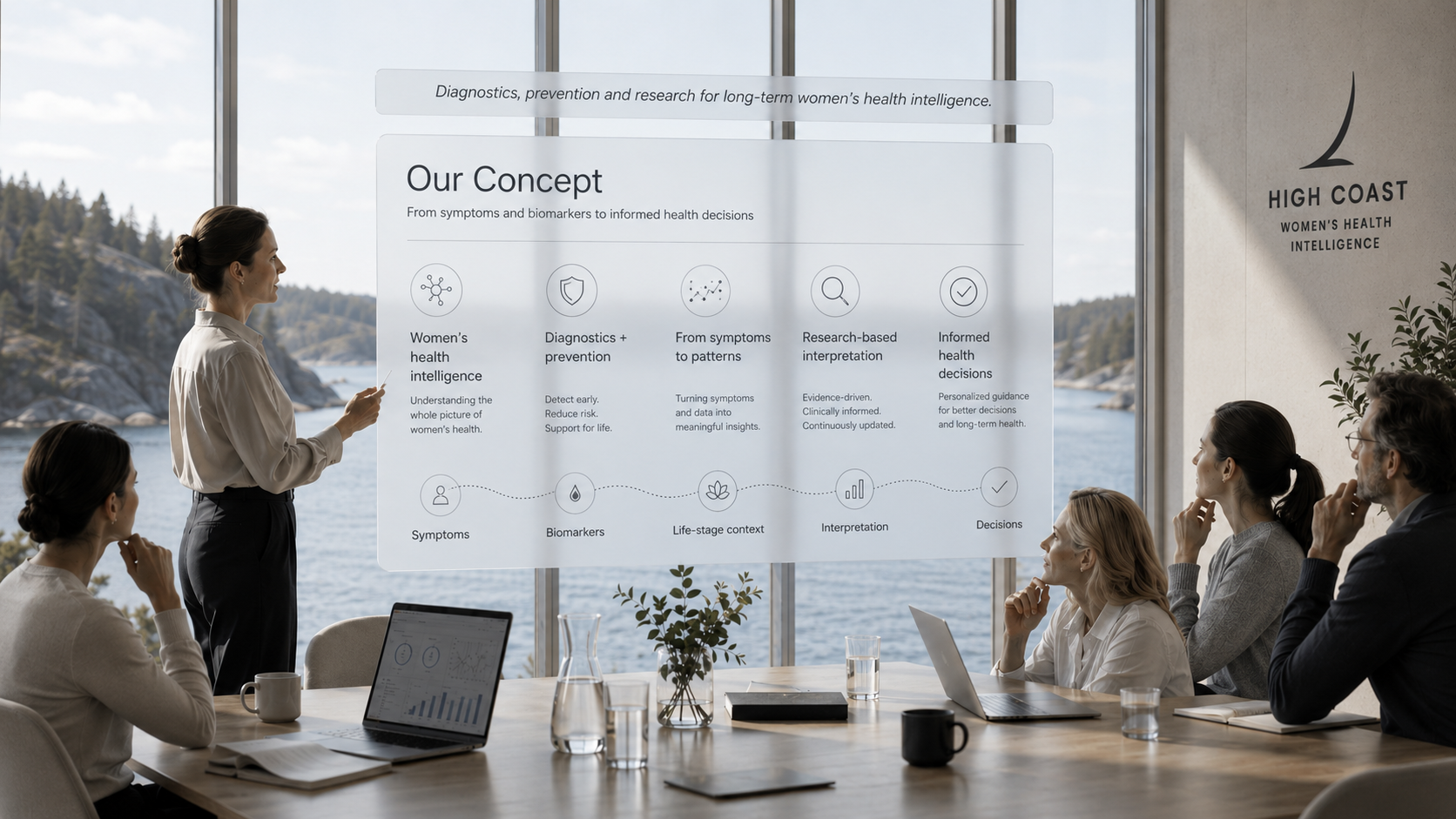
From symptoms and biomarkers to informed health decisions
Women’s health decisions are often made from fragmented information.
A symptom is assessed in one place.
A blood test is interpreted somewhere else.
A life-stage transition is discussed separately.
A fertility or pregnancy concern may be followed without enough connection to previous history.
Menopause may be treated as a short-term symptom issue rather than part of long-term metabolic, cardiovascular, bone and cognitive health.
High Coast Women’s Health Intelligence is built to address this fragmentation.
Our concept is to connect symptoms, biomarkers, life stage, medical history, diagnostics, prevention and research-based interpretation into a more structured model of women’s health.
The goal is not to replace clinical care.
The goal is to make health information clearer, more contextual and more useful for decisions.
Women’s health intelligence
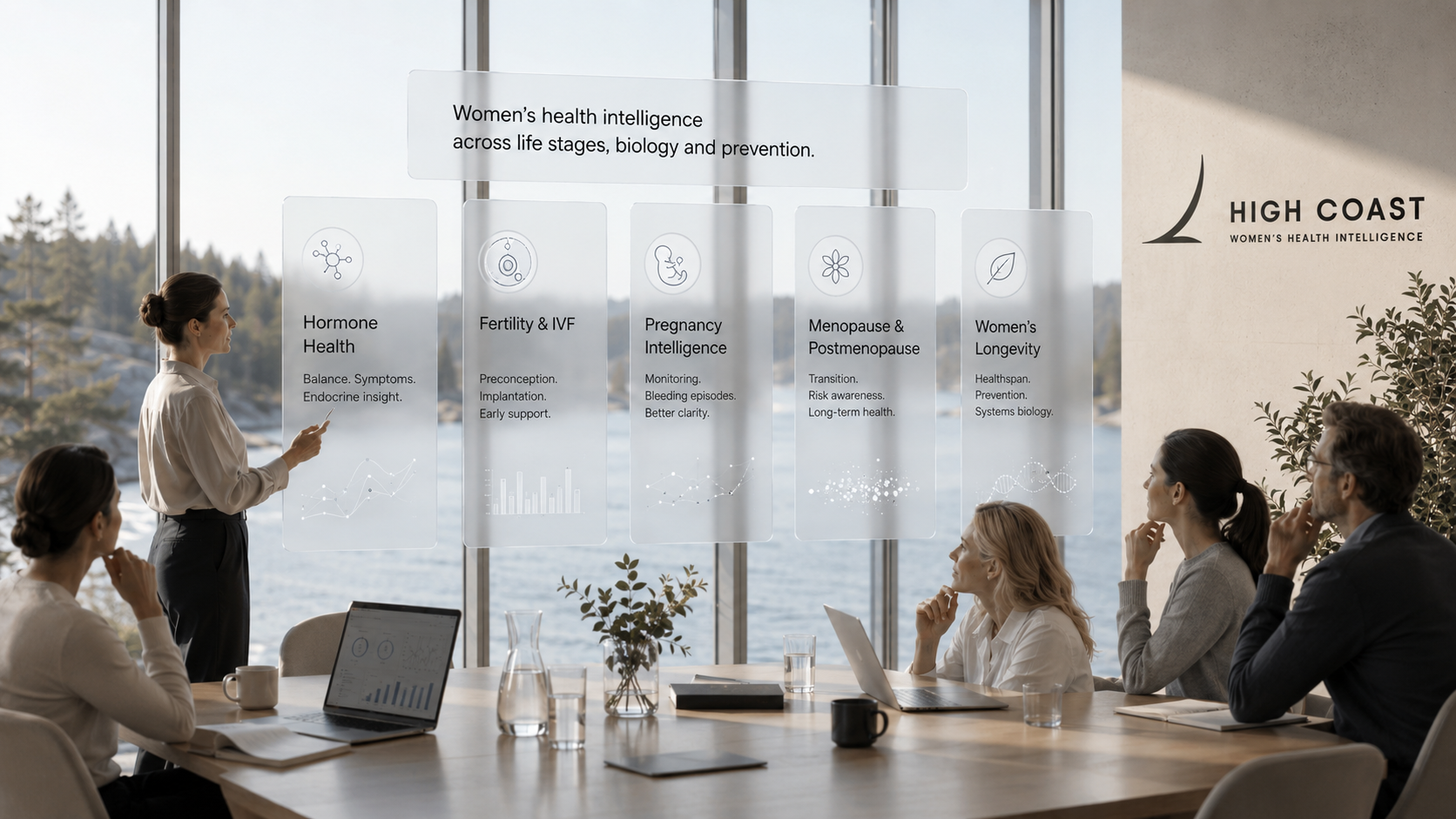
Women’s health intelligence means interpreting health information through the biology of women’s lives.
This includes the menstrual cycle, fertility, pregnancy, postpartum recovery, perimenopause, menopause, postmenopause and healthy aging. It also includes systems that are often treated separately: hormones, thyroid function, inflammation, metabolism, cardiovascular risk, bone health, cognition, sleep and tissue biology.
A women’s health intelligence model asks:
What is the woman experiencing?
What can be measured?
What life stage is she in?
What has changed over time?
What patterns are visible?
What is clinically relevant?
What is supported by evidence?
What needs expert review?
The purpose is to move from disconnected information toward structured understanding.
Diagnostics and prevention
Diagnostics become most valuable when they support prevention, interpretation and follow-up.
A test result should not exist as an isolated number. It should help answer a meaningful question:
What may explain this symptom?
What risk should be followed?
What has changed since the previous test?
What should be monitored over time?
What needs clinical review?
What decision can this support?
High Coast Women’s Health Intelligence uses diagnostics as part of a wider prevention framework.
This may include biomarkers related to hormones, thyroid function, inflammation, metabolism, fertility, pregnancy, menopause, cardiovascular health, bone health, micronutrients and long-term healthspan.
The aim is not to test everything.
The aim is to measure what matters.
From symptoms to patterns
Symptoms are important clinical signals, but they are often interpreted too narrowly.
Fatigue, pelvic pain, bleeding changes, cycle-related symptoms, sleep disturbance, mood changes, fertility problems, pregnancy concerns, hot flashes, weight change or cognitive symptoms may have several possible contributors.
A symptom may relate to hormones.
It may relate to thyroid function.
It may relate to inflammation.
It may relate to iron status, glucose regulation, stress physiology, sleep, medication, pregnancy stage, menopause transition or another medical condition.
The concept is therefore not to attach one simple explanation to one symptom.
The concept is to organize symptoms into patterns.
This includes:
- timing
- severity
- progression
- cycle phase
- pregnancy stage
- life stage
- associated symptoms
- biomarker context
- medical history
- treatment or medication exposure
A symptom becomes more useful when it is placed in context.
Research-based interpretation
Women’s health needs interpretation that is medically careful and scientifically honest.
Some areas are supported by strong clinical evidence.
Some areas are supported by emerging evidence.
Some remain hypotheses.
Some belong primarily in research.
High Coast Women’s Health Intelligence is built around this distinction.
When evidence is established, we say so.
When interpretation is uncertain, we say so.
When a model is conceptual or research-oriented, we make that clear.
This is especially important in areas such as fertility, implantation, pregnancy loss, endometriosis, inflammation, menopause, biological age and AI-supported interpretation.
The purpose is not to exaggerate certainty.
The purpose is to build a serious platform where women’s health information is interpreted responsibly.
Informed health decisions
Better information should lead to better decisions.
That does not always mean treatment. Sometimes the right decision is reassurance, repeat testing, symptom tracking, lifestyle change, clinical review, referral, closer pregnancy monitoring, a menopause assessment, fertility planning or participation in a structured program.
High Coast Women’s Health Intelligence is designed to support decisions such as:
- whether a symptom pattern should be followed
- whether a biomarker trend needs review
- whether a fertility or IVF history suggests a need for deeper interpretation
- whether pregnancy symptoms require routine follow-up or urgent assessment
- whether menopause symptoms should be assessed alongside metabolic and cardiovascular risk
- whether long-term prevention markers should be monitored over time
- whether a finding belongs in self-education, clinical care or research
The goal is clarity.
Not more noise.
Not more disconnected tests.
Not more vague advice.
Better interpretation.
Better follow-up.
Better decisions.
The High Coast model
Our concept can be summarized as a structured pathway:
symptoms → biomarkers → life-stage context → interpretation → decision support → follow-up → learning
This pathway connects clinical information with prevention and research.
It allows women’s health to be understood across time rather than through isolated events.
A fertility issue may connect to thyroid or metabolic context.
A pregnancy concern may connect to previous miscarriage or IVF history.
A menopause symptom may connect to cardiovascular, bone or cognitive health.
A longevity marker may connect to reproductive history, inflammation or metabolic risk.
Women’s health is not a collection of disconnected categories.
It is a biological journey.
What makes this different
High Coast Women’s Health Intelligence is not built around generic wellness language.
It is built around structured interpretation.
The difference is important.
We are not saying that every symptom needs extensive testing.
We are not saying that AI can diagnose complex women’s health conditions.
We are not saying that biomarkers explain everything.
We are not saying that prevention should create unnecessary worry.
We are saying that women’s health information becomes more useful when it is organized, interpreted and followed responsibly.
The concept is practical, scientific and long-term.
Measure what matters.
Interpret in context.
Separate evidence from hypothesis.
Use AI carefully.
Include clinical review when needed.
Learn over time.
From concept to platform
This concept supports the entire High Coast Women’s Health Intelligence platform.
It shapes how we build:
- health-area pages
- diagnostic panels
- prevention programs
- research articles
- visual explainers
- AI-supported reports
- pregnancy and fertility intelligence models
- menopause and longevity frameworks
- clinical and professional collaborations
The platform is designed to become more than a content site.
It is a structured women’s health intelligence system.
The long-term purpose is to connect diagnostics, prevention, research and clinical interpretation into a model that helps women and professionals make better health decisions across life.
Key message
High Coast Women’s Health Intelligence transforms symptoms, biomarkers and life-stage information into structured understanding.
Not just more tests.
Not just more content.
Not just more products.
A clearer model for women’s health decisions.
A stronger bridge between diagnostics, prevention and research.
A serious platform for long-term women’s health intelligence.