Core Idea
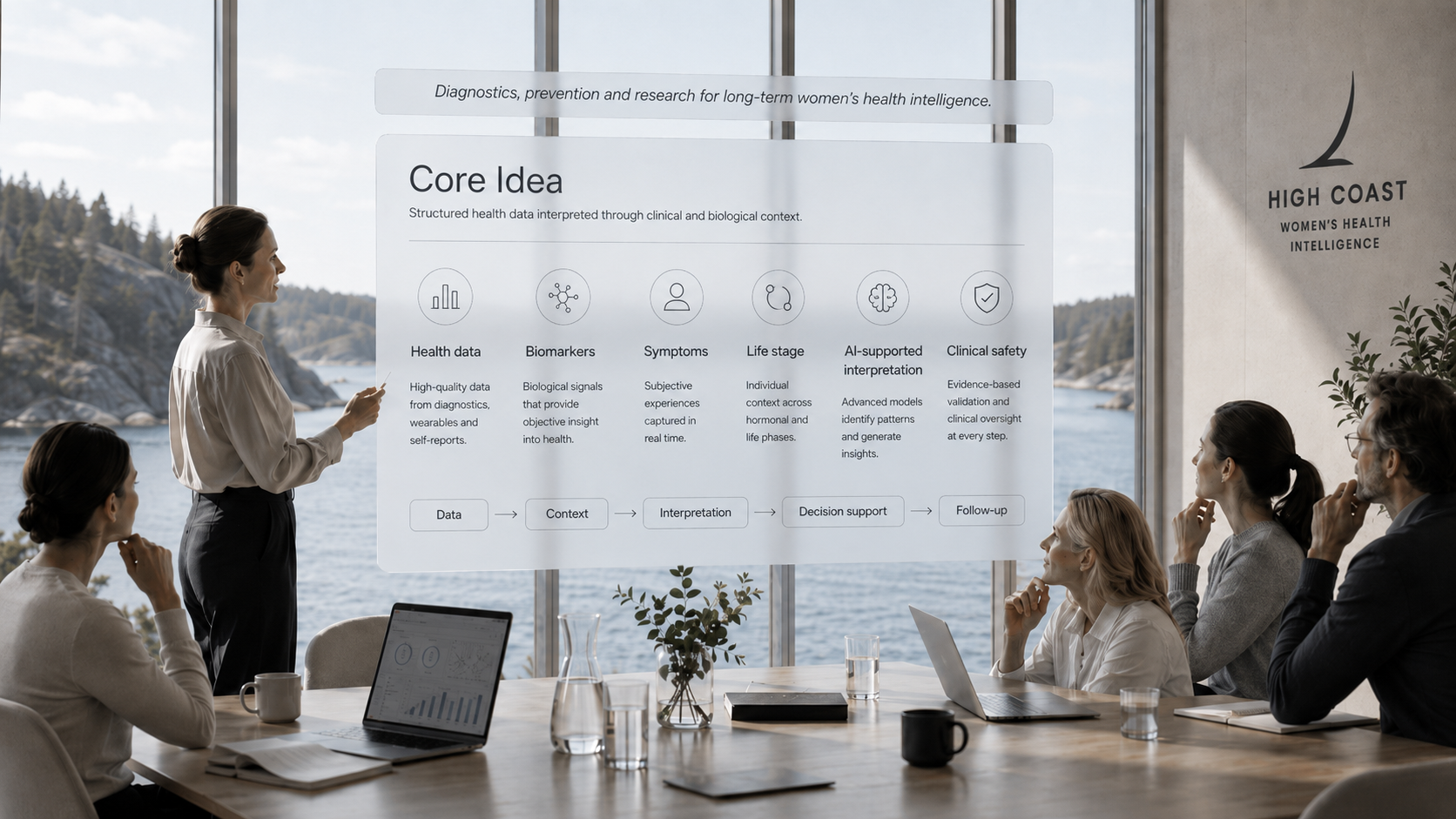
Structured health data interpreted through clinical and biological context
The core idea of High Coast Women’s Health Intelligence is simple:
Health information becomes more useful when it is structured, contextualized and interpreted over time.
A single symptom may be important.
A single biomarker may be useful.
A single test result may raise a question.
A single consultation may provide guidance.
But women’s health decisions often require more than isolated information.
They require connection.
Symptoms need context.
Biomarkers need timing.
Life stage changes interpretation.
Medical history matters.
Trends can be more informative than single snapshots.
AI can help organize complexity.
Clinical safety must define the boundaries.
High Coast Women’s Health Intelligence is built around this integrated model.
The purpose is not to create more data for its own sake. The purpose is to turn relevant health data into structured understanding that can support better prevention, clearer follow-up and more informed decisions.
Health data
Health data includes more than laboratory results.
It may include symptoms, medical history, cycle information, pregnancy history, fertility treatment history, menopause status, medications, imaging findings, wearable signals, lifestyle context and repeated measurements over time.
In women’s health, the meaning of health data is often highly dependent on timing and biological context.
A symptom during the luteal phase may mean something different from the same symptom after menopause.
A hormone value during fertility treatment may mean something different from the same value in a natural cycle.
Bleeding in early pregnancy is interpreted differently from bleeding after menopause.
A metabolic marker may carry different long-term meaning during perimenopause than it did earlier in life.
This is why health data must be organized.
The core idea is not simply to collect data.
It is to understand what kind of data matters, when it matters and what decision it may support.
Biomarkers
Biomarkers are measurable biological signals.
They may help describe endocrine function, thyroid status, inflammation, metabolic health, pregnancy development, fertility context, cardiovascular risk, micronutrient status, organ function or long-term prevention.
But biomarkers are not self-explanatory.
A biomarker needs interpretation.
It should be connected to:
- the reason it was measured
- symptoms
- age and life stage
- cycle phase or pregnancy stage where relevant
- previous values
- medication use
- clinical history
- risk factors
- follow-up questions
The central question is not only:
Is this result normal?
The better question is:
What does this result mean in this woman’s context, and what should happen next?
Symptoms
Symptoms are not noise. They are part of the health data landscape.
Fatigue, bleeding changes, pelvic pain, cycle symptoms, mood changes, sleep problems, weight change, hot flashes, fertility concerns, pregnancy symptoms, cognitive symptoms and postmenopausal symptoms all carry information.
But symptoms can have overlapping causes.
A symptom may reflect hormonal transition, thyroid dysfunction, anemia, inflammation, metabolic change, pregnancy-related change, medication effects, stress physiology, sleep disruption or another medical condition.
The core idea is to move from symptoms as isolated complaints to symptoms as structured patterns.
This means asking:
When did the symptom begin?
How severe is it?
Is it changing?
Is it related to the menstrual cycle?
Is it related to pregnancy stage, postpartum recovery or menopause transition?
Is it associated with biomarker changes?
Does it require clinical review?
A symptom becomes more useful when it is placed into a timeline.
Life stage
Women’s health changes across life.
Fertility, pregnancy, postpartum recovery, perimenopause, menopause, postmenopause and healthy aging all create different biological questions.
The same biomarker or symptom can mean different things depending on life stage.
For example:
- fatigue in early pregnancy may require a different interpretation than fatigue after menopause
- irregular bleeding during perimenopause is different from bleeding after menopause
- thyroid function may need different attention during fertility planning or pregnancy
- metabolic markers may become more important during menopause transition
- bone and cardiovascular risk become central in postmenopause
- cognitive symptoms may need interpretation through sleep, hormones, metabolism and vascular risk
Life stage is therefore not background information.
It is part of the interpretation model.
High Coast Women’s Health Intelligence uses life stage as a core layer in women’s health intelligence.
AI-supported interpretation
Women’s health information can become complex quickly.
A woman may have symptoms, repeated blood tests, fertility history, pregnancy history, ultrasound reports, medication changes, menopause symptoms, metabolic markers and clinical notes from different healthcare settings.
AI-supported interpretation can help organize this information.
It may support:
- timeline summaries
- symptom pattern recognition
- biomarker trend analysis
- life-stage mapping
- preparation for clinical consultations
- structured reports
- identification of missing information
- prioritization of findings that may need review
But AI must be used responsibly.
AI-supported interpretation is not the same as diagnosis. It should not replace clinicians, emergency care, specialist review or medical decision-making.
The role of AI is to support structure, clarity and continuity.
Not to create false certainty.
Clinical safety
Clinical safety is central to the High Coast model.
Women’s health intelligence must clearly distinguish between:
- education
- interpretation
- prevention support
- decision support
- clinical diagnosis
- urgent medical care
- research hypotheses
Not every symptom can be interpreted digitally.
Not every biomarker can be explained without clinical review.
Not every pattern is safe to monitor without medical assessment.
Some findings require human expertise.
This may include pregnancy warning symptoms, heavy bleeding, postmenopausal bleeding, severe pain, abnormal blood results, suspected thyroid disease, cardiovascular risk, severe mental health symptoms, rapidly worsening symptoms or unclear results that may require diagnosis or treatment.
The core idea is therefore not only to interpret data.
It is to know when interpretation must stop and clinical care must take over.
Evidence, hypotheses and uncertainty
A serious health intelligence platform must be honest about evidence.
Some clinical relationships are well established.
Some are probable but context-dependent.
Some are emerging.
Some are theoretical.
Some remain research questions.
High Coast Women’s Health Intelligence is designed to separate these levels clearly.
This is especially important in areas such as:
- implantation biology
- endometriosis and pregnancy risk
- inflammation and tissue-state models
- biological age testing
- AI-supported prediction
- menopause and long-term prevention
- longevity interventions
- recurrent pregnancy loss
The goal is not to make every model sound certain.
The goal is to create a trustworthy framework where evidence, uncertainty and future research can coexist.
From data to decisions
The core pathway is:
health data → biomarkers → symptoms → life stage → interpretation → clinical safety → decision support → follow-up → learning
Each step matters.
Data must be relevant.
Biomarkers must be interpreted.
Symptoms must be structured.
Life stage must guide meaning.
AI may help organize the information.
Clinical safety must set boundaries.
Decisions must be supported responsibly.
Follow-up must show what happens over time.
Learning can improve future models.
This is how health information becomes women’s health intelligence.
Why this core idea matters
Many women receive fragmented answers because their information is fragmented.
One symptom may be discussed without biomarker context.
One blood test may be interpreted without symptom timing.
One fertility problem may be separated from thyroid or metabolic health.
One pregnancy concern may be disconnected from prior loss or IVF history.
One menopause symptom may be separated from long-term cardiovascular, bone or cognitive risk.
High Coast Women’s Health Intelligence is built to connect these pieces.
Not by overpromising.
Not by replacing clinicians.
Not by turning every symptom into a diagnosis.
But by creating a structured model that helps women and professionals ask better questions, follow meaningful patterns and make more informed decisions.
Key message
The core idea is structured interpretation.
Health data alone is not enough.
Biomarkers alone are not enough.
Symptoms alone are not enough.
AI alone is not enough.
The value comes from connection:
health data, biomarkers, symptoms, life stage, AI-supported interpretation and clinical safety — interpreted together, responsibly and over time.