
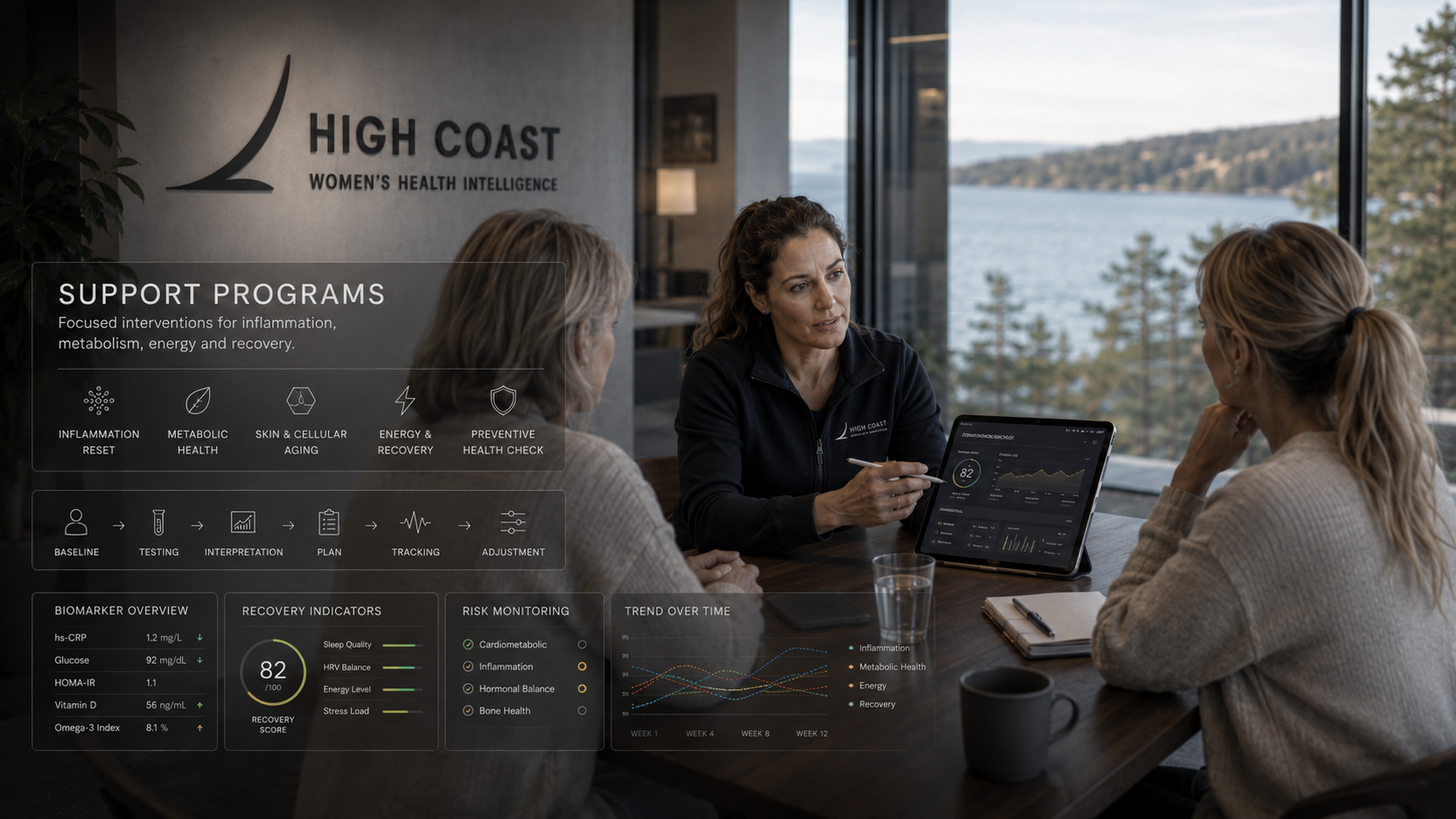
Support Programs
Focused interventions for inflammation, metabolism, energy and recovery
Women’s health is shaped by more than reproductive hormones alone.
Inflammation, metabolic health, sleep, recovery, stress physiology, nutrient status, skin and cellular aging all influence how women feel, function and age. These systems can also affect fertility, pregnancy, menopause, postmenopause and long-term prevention.
High Coast Women’s Health Intelligence develops support programs to focus on these cross-cutting biological systems.
Support programs are designed to help identify modifiable patterns, organize diagnostic information and support structured follow-up. They are not generic wellness plans. They are focused frameworks that connect symptoms, biomarkers, life stage and prevention.
The purpose is to move from vague advice to clearer interpretation and more actionable health pathways.

Why support programs matter
Many women’s health concerns are not limited to one diagnosis or one life stage.
Fatigue may involve iron status, thyroid function, inflammation, sleep, glucose regulation, perimenopause or recovery load.
Metabolic risk may influence fertility, pregnancy, menopause and cardiovascular prevention.
Inflammation may interact with endometriosis, pain, metabolic health, autoimmune tendency and long-term disease risk.
Skin and cellular aging may reflect hormonal transition, tissue repair, inflammation, nutrition, vascular health and oxidative stress.
Recovery problems may involve sleep, stress physiology, nutrition, training load, illness or hormonal change.
Support programs help structure these overlapping systems.
They ask:
What biological system is under strain?
What can be measured?
What symptoms are present?
What is modifiable?
What should be followed over time?
What needs clinical review?
What can support long-term prevention?
Inflammation Reset
Inflammation is a biological defense system, but persistent or dysregulated inflammation may contribute to symptoms, risk and reduced resilience.
Inflammation may be relevant in women with fatigue, pain, metabolic risk, endometriosis, autoimmune tendency, recurrent symptoms, post-infection recovery, menopause-related symptoms or long-term prevention concerns.
An Inflammation Reset program may include:
- symptom and medical history mapping
- inflammation markers where relevant
- metabolic markers
- sleep and recovery assessment
- nutrition and body-composition context
- pain and cycle-related symptom tracking
- medication and diagnosis review
- follow-up testing where appropriate
- clinical review when inflammation is significant or unexplained
The purpose is not to claim that inflammation explains everything.
The purpose is to identify whether inflammatory patterns are present, whether they may be modifiable and whether they require medical evaluation.
Inflammation should be interpreted carefully, because standard markers may be nonspecific and may not capture local tissue inflammation.
Metabolic Health
Metabolic health is central to women’s health across life.
Glucose regulation, insulin sensitivity, lipids, liver markers, blood pressure, abdominal fat distribution and body composition may influence fertility, pregnancy risk, menopause transition, cardiovascular prevention, energy and long-term healthspan.
A Metabolic Health program may focus on:
- fasting glucose
- HbA1c
- fasting insulin where relevant
- triglycerides
- HDL and LDL cholesterol
- ApoB where relevant
- liver markers
- blood pressure
- waist circumference
- body composition
- activity, nutrition and sleep context
- family history and pregnancy history
This program is especially relevant during perimenopause, menopause and postmenopause, when metabolic patterns may change.
The goal is prevention before disease becomes established.
Metabolic health should not be framed as weight alone. It is about biological risk, vascular health, energy regulation and long-term resilience.
Skin & Cellular Aging
Skin aging is often discussed cosmetically, but skin is also a biological tissue.
It reflects collagen structure, hormone exposure, inflammation, oxidative stress, nutrition, sun exposure, vascular function, sleep, metabolic health and tissue repair capacity.
A Skin & Cellular Aging program may include:
- skin and tissue-health history
- menopause and hormone context
- inflammation markers where relevant
- metabolic markers
- micronutrient status
- sleep and recovery assessment
- oxidative-stress and lifestyle context where appropriate
- body composition and vascular-risk context
- follow-up over time
The purpose is not to promise reversal of aging.
The purpose is to understand skin and cellular aging as part of women’s longevity and tissue health.
This program should remain serious and biologically grounded, avoiding cosmetic exaggeration or anti-ageing claims.
Energy and Recovery
Energy problems are common, but fatigue is not one diagnosis.
Low energy may involve iron deficiency, thyroid dysfunction, inflammation, sleep disruption, stress physiology, glucose regulation, perimenopause, pregnancy, postpartum recovery, medication effects, nutritional deficiency, chronic disease or mental health strain.
An Energy and Recovery program may include:
- fatigue and symptom timeline
- sleep and recovery assessment
- blood count and iron status
- thyroid markers
- vitamin B12, folate and vitamin D where relevant
- glucose and metabolic markers
- inflammation markers where relevant
- stress physiology and workload context
- menstrual, pregnancy, postpartum or menopause stage
- follow-up and clinical review where needed
The aim is to identify biological contributors and recovery barriers while recognizing that fatigue often has multiple causes.
The program should support clarity, not oversimplified explanations.
Preventive Health Check
A Preventive Health Check is designed to identify important health signals before problems become advanced.
It is not a random screening package. It should be structured around age, symptoms, life stage, family history, reproductive history, menopause status and long-term health goals.
A women’s preventive health check may include:
- blood pressure
- metabolic markers
- lipid and cardiovascular markers
- thyroid function
- blood count and iron status
- vitamin D and other micronutrients where relevant
- liver and kidney markers
- inflammation markers where appropriate
- body composition
- bone-health context
- symptom and lifestyle review
- clinical risk assessment where needed
The goal is to support earlier prevention, clearer follow-up and better long-term decisions.
A preventive check should not create unnecessary worry. It should create structure.
Support programs across life stages
Support programs can be used alongside the major women’s health programs.
Inflammation support may be relevant in endometriosis, fertility, pregnancy history, menopause symptoms or longevity.
Metabolic health may support fertility, pregnancy risk, menopause transition and cardiovascular prevention.
Energy and recovery may support postpartum health, perimenopause, chronic fatigue patterns and recovery after illness.
Skin and cellular aging may connect to menopause, tissue repair and longevity.
Preventive health checks may support women at many stages of life.
The same support program may therefore have different meaning depending on life stage.
Context is essential.
Diagnostics and follow-up
Support programs often begin with a structured baseline.
This may include symptoms, health history, life-stage context and diagnostic testing. Follow-up then helps determine whether patterns are stable, changing or responding to intervention.
A support program may follow this pathway:
baseline → testing → interpretation → plan → tracking → adjustment
The value often comes from repeated interpretation, not one-time measurement.
Some results require clinical review. Some require repeat testing. Some may support lifestyle, nutrition, sleep, recovery or prevention strategies. Some may reveal that a different program or specialist evaluation is more appropriate.
AI-supported support programs
AI-supported interpretation may help organize support-program data.
It can support:
- symptom timelines
- biomarker summaries
- trend analysis
- lifestyle and recovery context
- program progress tracking
- report generation
- follow-up reminders
- identification of findings needing review
AI should be used as a structure layer, not as a replacement for medical judgment.
This is especially important when symptoms are severe, markers are abnormal, pregnancy is involved, or clinical diagnosis and treatment may be required.
Clinical safety
Support programs must include clear escalation boundaries.
Clinical review may be needed with:
- severe or persistent fatigue
- unexplained weight loss
- abnormal inflammatory markers
- suspected autoimmune disease
- diabetes-range glucose markers
- high cardiovascular risk
- abnormal thyroid markers
- anemia or severe iron deficiency
- abnormal liver or kidney markers
- severe mood symptoms
- rapidly worsening symptoms
- pregnancy-related concerns
- postmenopausal bleeding
- any symptom that feels urgent or unusual
A responsible support program helps identify what can be managed through prevention and follow-up — and what needs clinical care.
The core principle
Support programs are designed to strengthen the biological systems that influence women’s health across life stages.
They are not quick fixes.
They are not generic wellness plans.
They are not substitutes for clinical care.
They are structured frameworks for focused biological support.
High Coast Women’s Health Intelligence uses support programs to connect inflammation, metabolism, energy, recovery, skin health, cellular aging and prevention into a clearer health intelligence pathway.
The core principle is simple:
Identify the pattern. Measure what matters. Support what can change. Follow over time. Escalate when needed.