How Programs Work
A stepwise model to test, interpret, plan, track and adjust
High Coast Women’s Health Intelligence programs are designed to create structure.
A program is not only a test package.
It is not only a report.
It is not only advice.
A program is a pathway.
Each program is built to connect symptoms, biomarkers, life stage, health history, interpretation and follow-up into a clearer process. The goal is to help women understand what is changing, what can be measured, what may be modifiable and what should be reviewed over time.
The core model is simple:
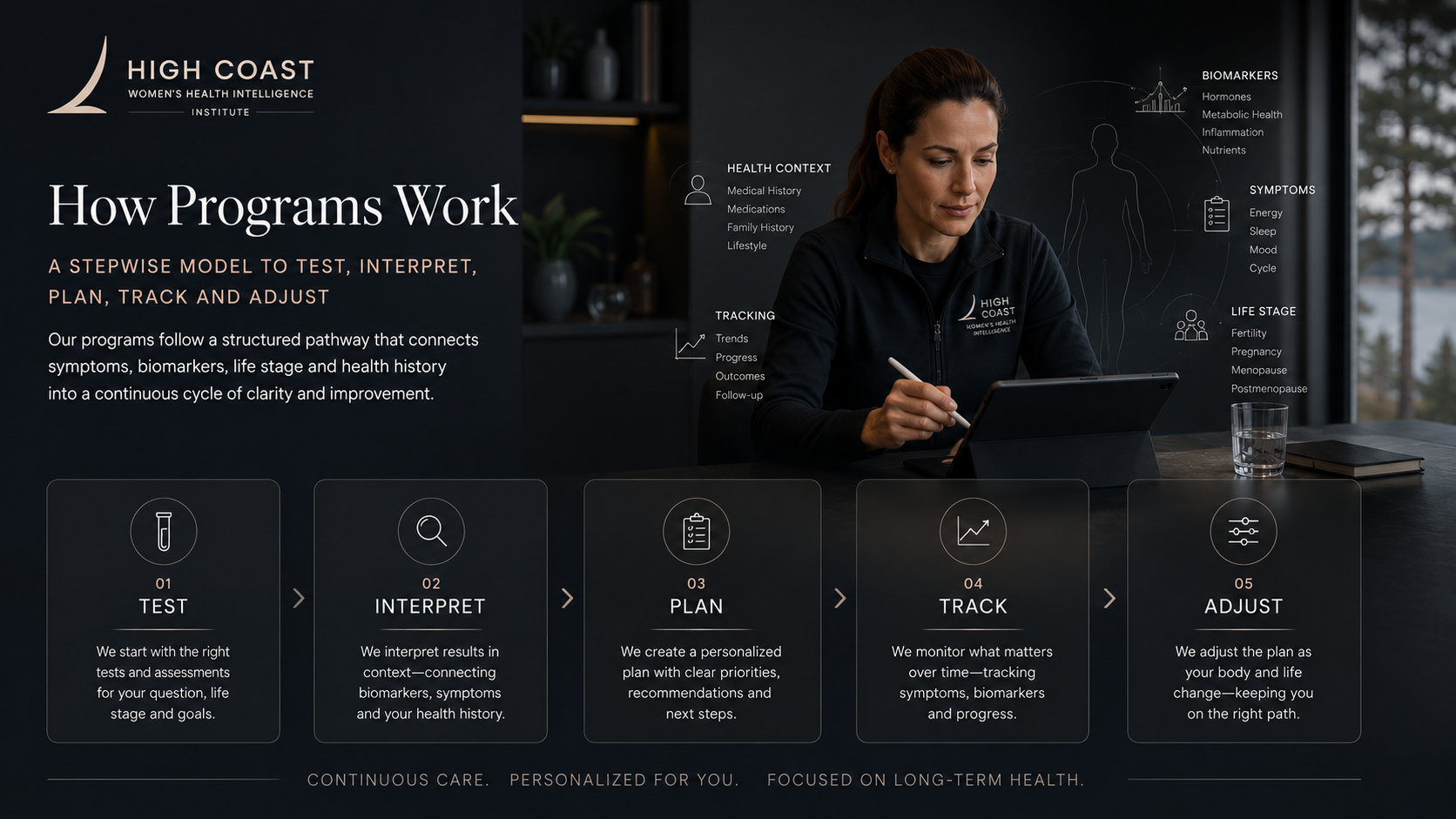
Test → Interpret → Plan → Track → Adjust
This stepwise structure can be applied across hormone health, fertility preparation, pregnancy intelligence, menopause, postmenopause, longevity, inflammation, metabolic health, energy and recovery.

Why a program model matters
Women’s health questions often unfold over time.
A single consultation may not capture the full pattern.
A single blood test may not show the direction of change.
A single symptom may not reveal the underlying context.
A single recommendation may need adjustment after follow-up.
This is why programs are built around sequence and feedback.
A structured program helps answer:
What is the starting point?
What should be measured?
What does the data mean?
What should be prioritized?
What plan is reasonable?
What should be tracked?
What should change if the results change?
When is clinical review needed?
A program creates continuity.
Step 1: Test
Testing begins with a question.
Before measuring anything, the program should clarify why testing is being done.
The question may relate to fatigue, cycle changes, fertility planning, pregnancy monitoring, menopause symptoms, metabolic risk, inflammation, postmenopausal prevention or long-term longevity.
Testing may include:
- biomarkers
- symptom questionnaires
- cycle timing
- pregnancy timeline
- blood pressure
- body composition
- metabolic markers
- thyroid markers
- inflammation markers
- micronutrient status
- fertility markers
- imaging or clinical findings where relevant
The goal is not to collect as much data as possible.
The goal is to measure what matters for the question, the life stage and the decision.
Step 2: Interpret
Interpretation turns data into meaning.
A result must be understood in context: symptoms, life stage, cycle phase, pregnancy status, menopause status, medication use, previous results, medical history and clinical risk.
A value that is normal in one context may be less reassuring in another.
A value outside range may require review, repeat testing or explanation through timing or treatment.
A symptom may become more meaningful when connected to a trend.
A trend may reveal change that a single snapshot misses.
Interpretation may include:
- biomarker interpretation
- symptom correlation
- trend analysis
- life-stage context
- risk prioritization
- AI-supported summaries
- clinical review where needed
The purpose is clarity.
Not overdiagnosis.
Not false reassurance.
Not exaggerated certainty.
Step 3: Plan
A plan connects interpretation to action.
The plan may be simple or detailed depending on the program and the findings.
It may include:
- reassurance and education
- repeat testing
- symptom tracking
- lifestyle and recovery strategies
- nutrition or micronutrient correction where appropriate
- fertility preparation
- pregnancy follow-up
- menopause assessment
- metabolic prevention
- clinical review
- referral or specialist discussion
- long-term monitoring
A plan should be realistic, medically careful and connected to the woman’s actual goal.
The plan should also define what is uncertain.
Not every finding leads to immediate action. Some require observation. Some require repeat testing. Some require clinical review. Some belong in research rather than routine care.
A good plan separates these clearly.
Step 4: Track
Tracking shows whether the situation is stable, improving, worsening or changing.
This is one of the most important differences between a one-time test and a structured program.
Tracking may include:
- symptoms over time
- biomarker trends
- cycle patterns
- pregnancy signals
- metabolic markers
- blood pressure
- body composition
- sleep and recovery
- medication or intervention effects
- follow-up test results
- clinical events
Tracking helps answer:
Is the plan working?
Are symptoms changing?
Are biomarkers improving?
Is a risk marker worsening?
Is follow-up needed sooner?
Should the plan be adjusted?
In many areas of women’s health, the trend is more useful than a single result.
Step 5: Adjust
Health programs must be flexible.
If symptoms change, results change or goals change, the program should adapt.
Adjustment may involve:
- changing the monitoring interval
- repeating selected tests
- adding new context
- changing the prevention focus
- escalating to clinical review
- modifying lifestyle or recovery strategies
- revisiting fertility or pregnancy planning
- reassessing menopause or metabolic risk
- updating the report or follow-up plan
The purpose of adjustment is to avoid static advice.
Women’s health is dynamic. Programs should be dynamic too.
The program pathway
The program pathway can be summarized as:
Test → Interpret → Plan → Track → Adjust
But behind these five steps is a deeper logic:
question → measurement → context → meaning → priority → action → follow-up → learning
This pathway helps transform health information into women’s health intelligence.
It also helps reduce confusion.
A test result has a place.
A symptom has a timeline.
A trend has a direction.
A plan has a purpose.
A follow-up has a reason.
AI-supported program structure
AI can support the program pathway by organizing information.
It may help with:
- summarizing symptoms
- structuring health history
- comparing biomarker trends
- identifying missing information
- preparing reports
- organizing follow-up
- highlighting findings that may need review
- tracking progress over time
But AI does not replace clinical judgment.
AI-supported interpretation should remain within clear boundaries. It should support clarity and continuity, not create unsupported diagnoses or automatic treatment decisions.
The safest role for AI is to help make complex information easier to understand and easier to review.
Clinical safety built into the pathway
Every program must include clinical safety.
Some findings are appropriate for education, prevention and tracking. Others require medical assessment.
Clinical review may be needed with:
- pregnancy warning symptoms
- heavy or unexplained bleeding
- bleeding after menopause
- severe pelvic pain
- abnormal thyroid markers
- anemia or severe iron deficiency
- diabetes-range glucose markers
- high cardiovascular risk
- abnormal liver or kidney markers
- significant inflammation
- severe mental health symptoms
- unexplained weight loss
- rapidly worsening symptoms
- abnormal or unclear results requiring diagnosis or treatment
A responsible program does not try to handle everything inside the program.
It helps identify when care should escalate.
Follow-up as a learning system
Follow-up is not only useful for the individual woman. It is also important for responsible learning.
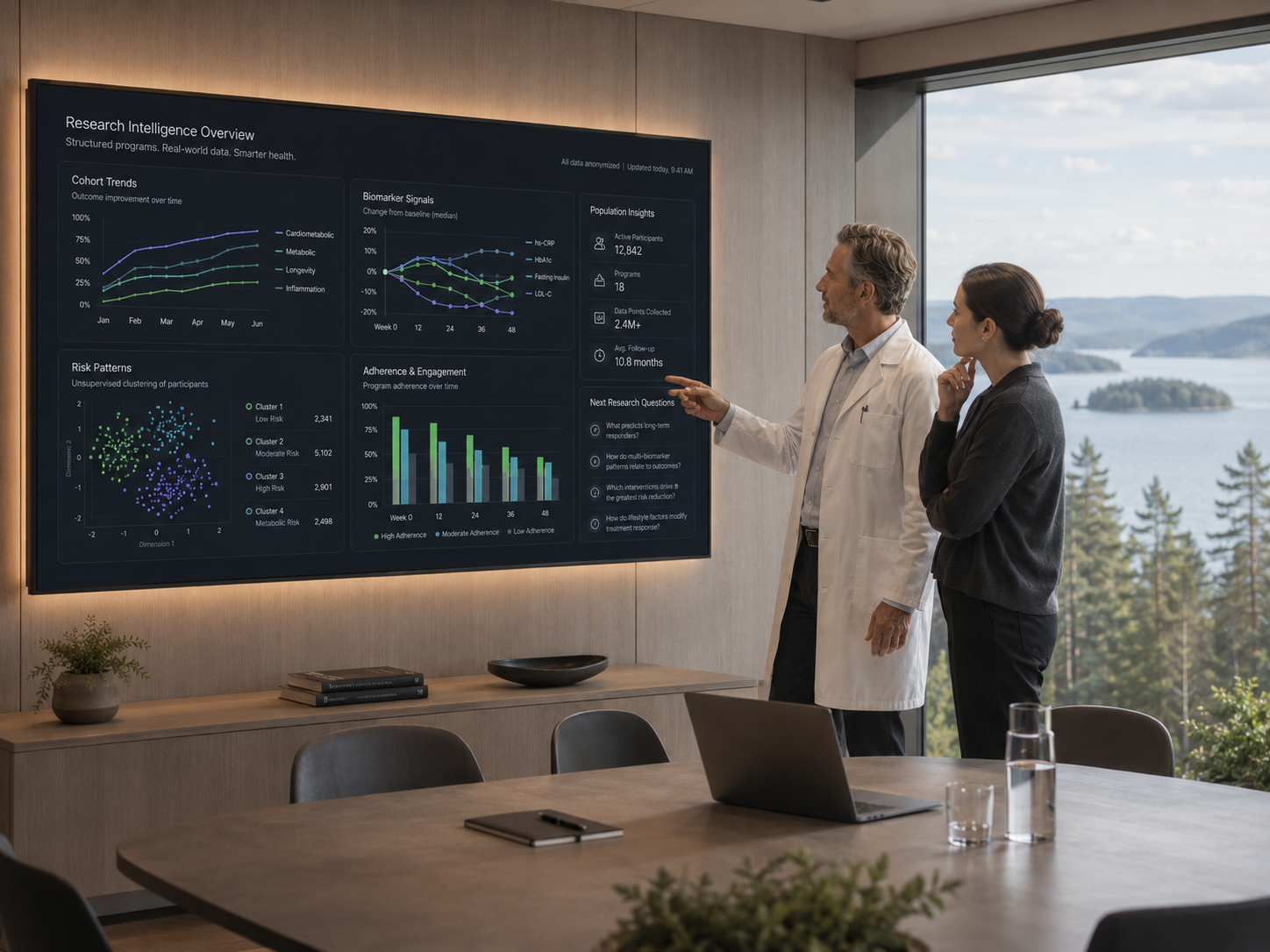
When symptoms, biomarkers, plans and outcomes are structured over time, patterns become easier to understand.
This can support:
- better reports
- improved program design
- more relevant testing strategies
- clearer escalation pathways
- research questions
- safer AI-supported interpretation
- long-term women’s health models
Learning must be responsible, ethical and transparent.
Personal health data should be handled with care. Evidence, hypotheses and uncertainty must remain clearly separated.
The goal is not only to collect data.
The goal is to learn in ways that improve women’s health decisions.
What programs are not
High Coast Women’s Health Intelligence programs are not generic wellness packages.
They are not designed to replace medical care.
They are not automatic diagnoses.
They are not one-size-fits-all protocols.
They are not based on testing everything.
They are not built around miracle claims.
They are not anti-ageing marketing.
They are structured frameworks for diagnostics, interpretation, prevention and follow-up.
The strength of the model is in the sequence:
test with purpose, interpret in context, plan responsibly, track over time and adjust when needed.
The core principle
Programs work best when they are structured but flexible.
They begin with a real question.
They measure relevant signals.
They interpret results in context.
They create a practical plan.
They track what changes.
They adjust when needed.
They escalate when safety requires it.
The core principle is simple:
Test. Interpret. Plan. Track. Adjust.