

A careful evidence review of maternal safety, fetal development, long-term child outcomes and common social media claims
Progesterone is one of the most important hormones in pregnancy.
It supports the uterine lining, helps maintain early pregnancy, influences immune regulation and plays a role in reducing uterine activity. Without adequate progesterone signaling, pregnancy cannot be established or maintained normally.
Because of this, progesterone treatment is commonly used in reproductive medicine and obstetrics. It may be prescribed after IVF, during early pregnancy bleeding in women with previous miscarriage, in selected cases of recurrent miscarriage, and in some preterm birth prevention strategies.
But an important question remains:
Can long-term or high-dose progesterone treatment throughout pregnancy be harmful?
The answer is not a simple yes or no.
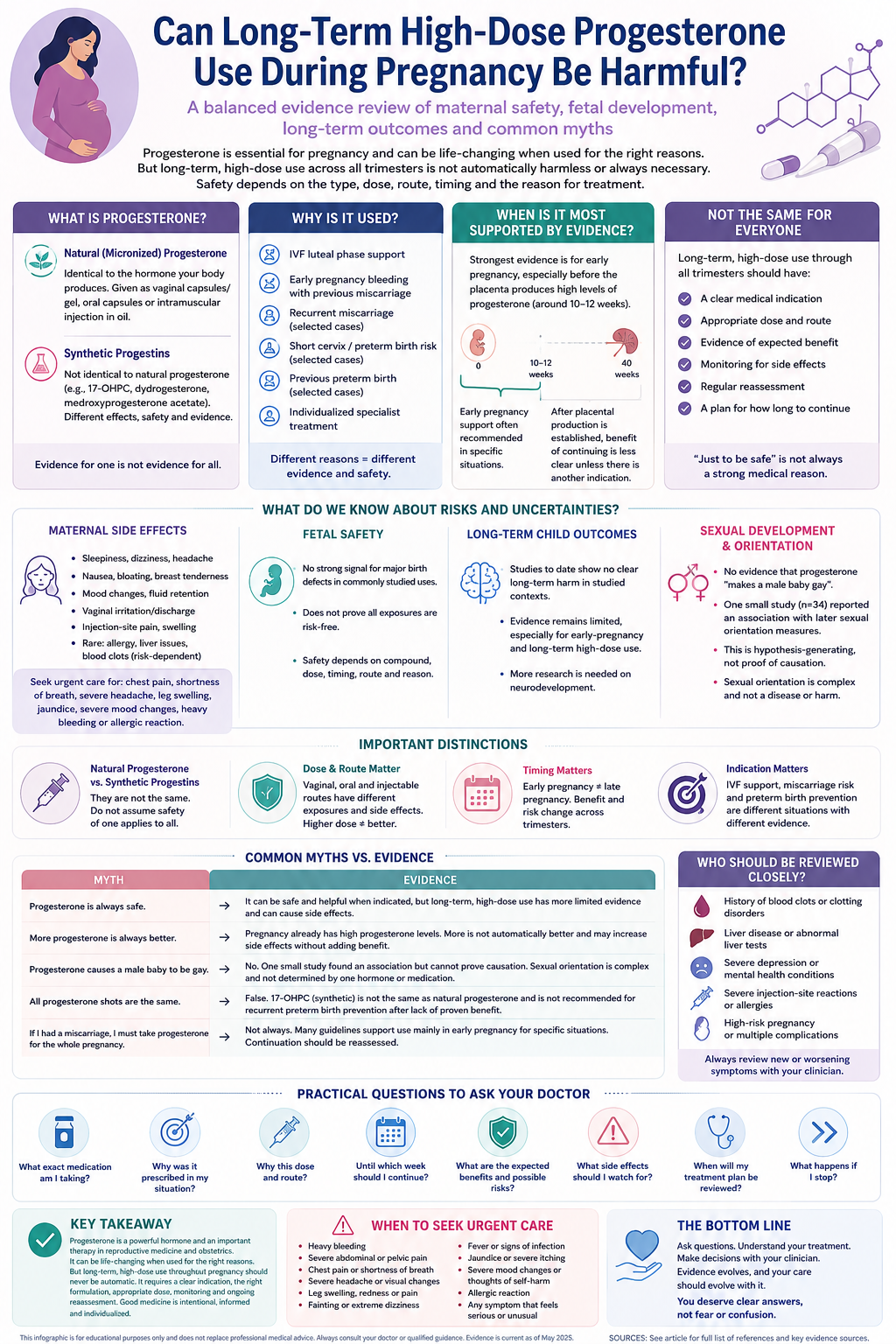
Progesterone can be appropriate and helpful in selected situations. But long-term, high-dose use across all trimesters is a different question from short-term luteal support or guideline-based early pregnancy treatment. The safety profile depends on the type of progesterone, the dose, the route, the reason for treatment, the trimester of exposure and the maternal risk profile.
This article reviews the evidence carefully, including maternal side effects, fetal development, long-term child outcomes, neurodevelopmental concerns, sexual development, the small sexual-orientation study often discussed online, and the difference between evidence, hypothesis and myth.
First: what do we mean by “progesterone”?
The word “progesterone” is often used loosely.
But different treatments are not the same.
Natural or micronized progesterone
Natural progesterone usually refers to micronized progesterone, which is chemically identical to endogenous human progesterone.
It may be given as:
-
vaginal capsules
-
vaginal gel
-
vaginal pessaries
-
oral capsules
-
intramuscular injection in oil
This is the form often used in IVF luteal support and early pregnancy support.
Synthetic progestins
Synthetic progestins are progesterone-like compounds, but they are not identical to natural progesterone.
Examples include:
-
dydrogesterone
-
17-alpha hydroxyprogesterone caproate, often called 17-OHPC
-
medroxyprogesterone acetate
-
other progestins used in contraception or hormone therapy
These compounds may have different receptor activity, metabolism, potency and safety considerations.
This distinction matters because evidence from one progestogen cannot automatically be applied to all others.
A discussion about “progesterone safety” must always ask:
Which compound? Which dose? Which route? Which trimester? Which indication?
Why progesterone is used in pregnancy
Progesterone treatment may be used for several different reasons.
Common contexts include:
-
IVF luteal phase support
-
frozen embryo transfer cycles
-
early pregnancy bleeding with previous miscarriage
-
recurrent miscarriage in selected cases
-
short cervix and preterm birth risk
-
previous spontaneous preterm birth, although guidance has changed
-
individualized specialist treatment in complex pregnancies
These are not the same situation.
A woman using progesterone for two weeks after embryo transfer is not the same as a woman using high-dose injections through all three trimesters. A woman with early bleeding and previous miscarriage is not the same as a woman receiving long-term preterm birth prevention. A short cervix strategy is different from routine progesterone without a clear indication.
Safety and benefit must be assessed in relation to the clinical reason for treatment.
What current guidelines generally support
Most guideline-supported progesterone use in pregnancy is specific and limited, not open-ended.
For early pregnancy bleeding in women with previous miscarriage, some guidelines support vaginal micronized progesterone during early pregnancy. In this setting, progesterone is intended to support the early pregnancy period, especially before placental progesterone production becomes dominant.
In many protocols, progesterone is stopped around the end of the first trimester or around 12–16 weeks, depending on the indication and guideline.
For preterm birth prevention, the evidence is more complicated. Vaginal progesterone may still be considered in selected patients, especially in relation to cervical length, but routine use for all women with previous preterm birth is no longer supported in the same way. The synthetic injectable progestin 17-OHPC has been withdrawn in the United States for recurrent preterm birth prevention because benefit was not confirmed.
This means that “progesterone during pregnancy” should not be treated as one universal therapy.
The key clinical question is:
What is the evidence-based indication for continuing it?
The specific question: long-term high-dose use through all trimesters
Long-term high-dose progesterone use throughout pregnancy is not the same as standard early pregnancy progesterone support.
The evidence base for full-pregnancy exposure is more limited and more heterogeneous.
Important questions include:
-
Is there a clear diagnosis or risk factor?
-
Is the treatment natural progesterone or synthetic progestin?
-
Is the route vaginal, oral or intramuscular?
-
What is the dose?
-
Was treatment started before conception, in the first trimester or later?
-
Is it continued after the placenta has taken over progesterone production?
-
Is there evidence that continuing treatment improves outcome?
-
Are maternal side effects being monitored?
-
Are there fetal or long-term child outcome concerns?
-
Is clinical review ongoing?
The safest position is not that long-term progesterone is automatically dangerous.
But it is also not scientifically responsible to say that long-term high-dose use throughout pregnancy is automatically harmless.
The evidence is not strong enough for that.
Maternal side effects
Progesterone can cause side effects in the pregnant person.
Many are mild, but some can be clinically relevant.
Possible side effects include:
-
sleepiness
-
dizziness
-
headache
-
nausea
-
bloating
-
breast tenderness
-
mood changes
-
fluid retention
-
vaginal irritation or discharge with vaginal use
-
injection-site pain, swelling or inflammation with intramuscular use
-
local allergic reactions
-
worsening depression in susceptible individuals
-
liver-related concerns in women with hepatic disease
-
possible thromboembolic concerns in women with clotting risk, depending on formulation and risk profile
Intramuscular progesterone in oil can be particularly uncomfortable and may cause injection-site reactions. Oral progesterone can be more sedating because of first-pass metabolism and neuroactive metabolites. Vaginal progesterone may cause local irritation, discharge or discomfort.
In most medically supervised uses, progesterone is tolerated. But tolerance does not mean absence of risk.
A woman taking high-dose progesterone for many months should have a clear reason, monitoring plan and review of side effects.
Pregnancy-specific maternal safety concerns
Some symptoms during progesterone treatment should not simply be dismissed as “normal pregnancy.”
Clinical review may be needed if there is:
-
severe dizziness or fainting
-
severe headache or visual symptoms
-
chest pain or shortness of breath
-
unilateral leg swelling or pain
-
severe mood symptoms
-
jaundice or intense itching
-
severe abdominal pain
-
heavy bleeding
-
signs of allergic reaction
-
worsening depression
-
severe injection-site inflammation
-
abnormal liver markers
-
any symptom that feels urgent or rapidly worsening
These symptoms may not be caused by progesterone, but they should still be assessed.
Pregnancy itself changes clotting, liver function, blood pressure risk and mental health vulnerability. Adding long-term hormonal treatment should be done with clinical awareness.
Fetal safety: what is known
Natural progesterone is biologically central to pregnancy, and progesterone treatment has been used widely in reproductive medicine and obstetrics.
In the usual studied settings, progesterone has not shown a clear major teratogenic signal comparable to known harmful pregnancy exposures.
However, absence of a clear major malformation signal is not the same as complete certainty about all developmental outcomes.
Fetal safety depends on:
-
compound
-
dose
-
timing
-
duration
-
route
-
maternal condition
-
reason for treatment
-
co-medications
-
pregnancy complications
-
study quality
The strongest reassurance applies to commonly studied, clinically indicated use — not necessarily to high-dose, full-pregnancy exposure without a clear indication.
Natural progesterone vs synthetic progestins and fetal development
Different progestogens may have different fetal implications.
Natural progesterone has a different biological profile from synthetic progestins. Some older synthetic hormonal exposures have raised concerns about fetal genital development, especially when androgenic activity is involved. Natural progesterone is not the same as androgenic progestins.
This is why discussions must avoid mixing all “progesterone-like” drugs into one category.
A key part of any safety review is to identify the exact medication.
Questions to ask include:
-
Is this micronized progesterone?
-
Is it intramuscular progesterone in oil?
-
Is it dydrogesterone?
-
Is it 17-OHPC?
-
Is it another synthetic progestin?
-
Is it combined with estrogen or another hormone?
-
Is it compounded or regulated?
-
What dose is being used?
Without this information, the safety discussion is incomplete.
Long-term child outcomes
A major question is whether prenatal progesterone exposure affects children later in life.
A systematic review of long-term child outcomes after prenatal progesterone treatment for preterm birth prevention found no clear evidence of long-term benefit or harm for child development, behavior or health. However, the available data were limited, especially for some formulations, timings and first-trimester exposures.
This is important.
The evidence does not show a strong long-term harm signal in the studied contexts, but the evidence also does not prove that every form of prolonged progesterone exposure is risk-free.
Long-term outcomes are difficult to study because many children exposed to progesterone were exposed because the pregnancy was already higher risk. This creates confounding.
For example, if a child later has developmental differences, it may be difficult to know whether this relates to:
-
progesterone exposure
-
the underlying pregnancy risk
-
preterm birth risk
-
IVF or infertility background
-
maternal illness
-
bleeding or inflammation
-
placental factors
-
genetics
-
environmental factors
-
other medications
This is why observational studies must be interpreted carefully.
Neurodevelopmental concerns
Some studies have raised questions about possible neurodevelopmental associations after prenatal progestogen exposure.
These include outcomes such as developmental scores, autism spectrum disorder signals or other behavioral measures. However, the evidence is not consistent enough to support a simple causal conclusion.
There are several reasons for caution:
-
many studies are observational
-
underlying pregnancy risk may confound results
-
treatment indications differ
-
formulations differ
-
timing and dose differ
-
developmental outcomes are influenced by many factors
-
exposed and unexposed groups may not be comparable
It is scientifically reasonable to study neurodevelopmental outcomes further.
It is not scientifically responsible to claim that progesterone clearly causes neurodevelopmental disorders based on current evidence.
The correct conclusion is:
No strong causal conclusion is established, but long-term child outcomes remain an important area for continued research, especially for prolonged, high-dose and early-pregnancy exposure.
Sexual development and genital effects
A common fear is that progesterone could “feminize” a male fetus or “masculinize” a female fetus.
This needs careful separation.
Natural progesterone is not testosterone. It does not act like a strong androgen. It is not expected to masculinize a female fetus in the way androgenic compounds could.
Some historical concerns about genital effects relate more to certain synthetic progestins or hormonal exposures, not ordinary micronized progesterone used in standard reproductive protocols.
For male fetal development, there is no strong evidence that natural progesterone used appropriately causes genital feminization.
However, fetal sexual differentiation is hormonally sensitive, especially early in development. This is one reason why unnecessary hormone exposure during pregnancy should always have a clear indication.
The evidence does not support dramatic claims that medically prescribed progesterone routinely disrupts fetal sexual development.
But the principle remains:
Use hormones in pregnancy when there is a reason, not casually.
The sexual-orientation study: what it found and what it does not prove
One study often discussed online is the paper reporting an association between prenatal progesterone exposure and later sexual orientation in humans.
This study compared 34 prenatally progesterone-exposed individuals with matched controls. The authors reported that exposed individuals were less likely to identify as heterosexual and more likely to report some same-sex attraction or behavior. The authors suggested that prenatal progesterone exposure may warrant further investigation as a possible developmental factor.
This study should be mentioned honestly.
It should not be ignored.
But it must also be interpreted correctly.
What the study can say
The study reported an association in a small historical sample.
It raises a hypothesis that prenatal progestogen exposure could, in some way, be associated with later psychosexual development.
It is a legitimate research question.
What the study cannot say
The study cannot prove causation.
It cannot show that progesterone “makes a male baby gay.”
It cannot quantify risk for modern progesterone treatment.
It cannot answer the question of high-dose use throughout all trimesters.
It cannot separate all possible confounding factors.
It included a very small sample.
The exposure context was historical, and treatment indications may themselves reflect pregnancy biology that differs between groups.
Sexual orientation is also not a disease, defect or harm. It should not be framed as a negative outcome. The scientific question is whether prenatal hormone exposure may influence aspects of sexual development, not whether it causes “damage.”
The careful conclusion is:
A small study reported an association between prenatal progesterone exposure and later sexual orientation measures. This is hypothesis-generating, not proof of causation. It should be discussed respectfully and scientifically, not used as a social media fear claim.
Can progesterone “make a baby gay”?
No evidence supports that wording.
Sexual orientation is complex. It is not determined by one medication, one hormone level or one pregnancy exposure. Genetics, prenatal biology, developmental factors and many unknown mechanisms may all contribute.
The available progesterone evidence does not justify the claim that progesterone treatment makes a male baby gay.
A better scientific statement is:
There is limited, hypothesis-level evidence that prenatal progestogen exposure may be associated with later sexual orientation measures in one small study. This finding requires replication and does not establish causation or clinical risk.
That is very different from the social media claim.
Miscarriage prevention: benefit and limits
Progesterone has a plausible and clinically important role in early pregnancy support.
In selected women, especially those with early pregnancy bleeding and previous miscarriage, progesterone may improve live birth chances. This is why some guidelines recommend offering vaginal progesterone in that specific setting.
But this does not mean progesterone should automatically be continued for the whole pregnancy.
The biological rationale is strongest in early pregnancy, before the placenta becomes the dominant source of progesterone production.
After placental progesterone production is established, the benefit of continuing progesterone may be less clear unless there is another indication.
This is one of the most important points for patient education:
Evidence for early pregnancy progesterone support does not automatically justify high-dose progesterone throughout all three trimesters.
IVF and luteal support
Progesterone is commonly used after IVF and embryo transfer because assisted reproduction can disrupt or replace normal luteal function.
In IVF, progesterone support is often essential in the early phase.
However, many IVF protocols stop progesterone around 8–12 weeks, once placental hormone production is expected to be established. Some clinics continue longer depending on protocol, patient history or clinician preference.
The key point is that IVF luteal support is not the same as indefinite pregnancy-long progesterone.
If progesterone is continued beyond the first trimester after IVF, there should be a reason and a plan.
Preterm birth prevention and the 17-OHPC controversy
Progesterone and progestogens have also been used to reduce the risk of preterm birth.
This area has changed significantly.
The synthetic injectable progestin 17-OHPC was previously used for women with a history of spontaneous preterm birth. However, after further evidence failed to confirm benefit, the FDA withdrew approval of Makena and generics in the United States. ACOG updated its guidance accordingly.
This is important because many people online refer to “progesterone shots” without distinguishing natural progesterone from 17-OHPC.
They are not the same.
For preterm birth prevention, vaginal progesterone may still be considered in selected situations, especially involving short cervix, but this is a specialist decision.
The lesson is broader:
Long-term pregnancy hormone treatment must be continuously re-evaluated as evidence changes.
Dose matters
A low or standard dose used for a defined indication is not the same as high-dose treatment.
High-dose use may increase maternal side effects, treatment burden and uncertainty, especially if continued without clear evidence of benefit.
Dose-related questions include:
-
What is the daily or weekly dose?
-
Is it higher than standard protocols?
-
Is it being combined with other hormones?
-
Is the route increasing systemic exposure?
-
Are blood levels being monitored?
-
Is there evidence that this dose is needed?
-
Is there a stop date or reassessment point?
More progesterone is not automatically better.
Pregnancy already involves very high endogenous progesterone levels, especially later in gestation. Supplementation after placental production is established should therefore have a clear clinical rationale.
Route matters
The route of progesterone administration changes exposure and side effects.
Vaginal progesterone
Often used for reproductive and obstetric indications. It may provide high local uterine exposure with lower systemic sedating effects than oral use.
Possible side effects include discharge, irritation and discomfort.
Oral progesterone
May cause more sleepiness or dizziness due to metabolism into neuroactive compounds.
Intramuscular progesterone
Can produce reliable systemic exposure but may cause injection-site pain, swelling, inflammation or rare complications.
Synthetic injections
17-OHPC and other progestins are not the same as natural progesterone and should be evaluated separately.
The route should match the indication.
What about using progesterone “just to be safe”?
This is common in emotionally difficult pregnancies, especially after miscarriage, IVF or bleeding.
The intention is understandable.
But “just to be safe” is not always a strong medical reason for prolonged treatment.
A treatment can be reasonable when:
-
there is evidence of benefit for the situation
-
the expected benefit outweighs risk
-
the formulation and dose are appropriate
-
there is a follow-up plan
-
there is a stopping point or reassessment
-
side effects are monitored
A treatment is less defensible when:
-
there is no clear indication
-
dose is high without rationale
-
treatment continues indefinitely
-
side effects are ignored
-
the patient is not told about uncertainty
-
the medication type is unclear
-
the plan is driven only by fear
Good medicine does not dismiss anxiety. It structures it into safer decision-making.
What is known, uncertain and myth
Established
Progesterone is essential for pregnancy.
Progesterone can be useful in selected reproductive and obstetric settings.
Early pregnancy progesterone may benefit women with bleeding and previous miscarriage.
Progesterone treatment can cause maternal side effects.
Different progestogens are not the same.
17-OHPC is no longer supported in the same way for recurrent preterm birth prevention after lack of confirmed benefit.
Reasonably reassuring
In commonly studied contexts, progesterone has not shown a strong signal of major fetal harm.
Long-term child outcome data have not shown clear major harm in the studied preterm birth prevention contexts.
Uncertain
The safety of prolonged high-dose progesterone across all trimesters is less well established.
Long-term neurodevelopmental outcomes need more research.
Different formulations and routes may not have identical risk profiles.
The sexual-orientation study is hypothesis-generating and needs replication.
Myth or overstated claim
Progesterone does not simply “make a male baby gay.”
Progesterone is not automatically dangerous.
Progesterone is not automatically harmless.
Natural progesterone and synthetic progestins should not be treated as identical.
A normal pregnancy hormone does not mean unlimited supplementation is risk-free.
Practical clinical questions to ask
Any pregnant woman using long-term or high-dose progesterone should be able to ask:
-
What exact medication am I taking?
-
Is it natural micronized progesterone or a synthetic progestin?
-
Why was it prescribed?
-
What evidence supports it for my situation?
-
What dose am I using compared with standard protocols?
-
Why this route: vaginal, oral or injection?
-
Until which gestational week should I continue?
-
What is the expected benefit after the first trimester?
-
What side effects should I watch for?
-
Do I have liver, clotting, mood or other risk factors?
-
What symptoms require urgent care?
-
When will the plan be reviewed?
-
What happens if I stop?
-
Is there a difference between emotional reassurance and medical benefit?
These questions do not mean the treatment is wrong.
They mean the treatment should be intentional.
Balanced conclusion
Progesterone is not a fringe treatment. It is central to pregnancy biology and has legitimate medical uses in fertility care and obstetrics.
But long-term high-dose progesterone use throughout pregnancy should not be treated as automatically evidence-based or risk-free.
The strongest evidence supports specific uses in specific contexts. The most common medically supported use is time-limited, often focused on early pregnancy or selected preterm birth risk situations. Prolonged exposure across all trimesters, especially at high dose, has a more limited evidence base and should be individualized.
Maternal side effects are real. Fetal major-harm signals are not clearly established in usual studied contexts, but long-term developmental questions remain scientifically important. The sexual-orientation study should be discussed honestly as a small hypothesis-generating study, not ignored and not exaggerated.
The best answer is therefore:
Progesterone can be appropriate and beneficial when clearly indicated. Long-term high-dose use throughout pregnancy should require a clear indication, formulation-specific reasoning, maternal monitoring, evidence-based counseling and periodic reassessment. It should not be continued simply because “more progesterone must be safer.”
The scientific principle is simple:
Use progesterone when the expected benefit is clear. Use the right formulation, at the right dose, for the right duration. Be honest about uncertainty. Monitor carefully. Reassess over time.
Key evidence sources
NICE NG126 Evidence Review C: Progestogens for Preventing Miscarriage
National Institute for Health and Care Excellence / Royal College of Obstetricians and Gynaecologists
Evidence review behind NICE recommendations on progesterone for preventing miscarriage, including the use of vaginal micronized progesterone in women with early pregnancy bleeding and previous miscarriage. Useful for explaining why many protocols focus on early pregnancy rather than routine full-pregnancy use.
Updated Clinical Guidance for the Use of Progestogen Supplementation for Prevention of Recurrent Preterm Birth
American College of Obstetricians and Gynecologists
Updated ACOG guidance after the FDA withdrawal of 17-OHPC/Makena. Important for distinguishing natural progesterone from synthetic progestins and for explaining why long-term progestogen injections for recurrent preterm birth are no longer treated as broadly evidence-supported.
The Long-Term Effect of Prenatal Progesterone Treatment on Child Development, Behaviour and Health: A Systematic Review
BJOG: An International Journal of Obstetrics & Gynaecology
Systematic review of long-term child outcomes after prenatal progesterone treatment, mainly in the context of preterm birth prevention. Found no clear evidence of long-term benefit or harm in studied settings, while emphasizing that evidence remains limited, especially for early pregnancy exposure and longer follow-up.
Prenatal Exposure to Progesterone Affects Sexual Orientation in Humans
Archives of Sexual Behavior / Springer
Small case-control study of 34 prenatally progesterone-exposed individuals reporting an association with later sexual-orientation measures. Important to discuss because it appears in social media debates, but it is hypothesis-generating, not proof of causation, and does not show that progesterone “makes a male baby gay.”
Progesterone Injection Prescribing Information
DailyMed / U.S. National Library of Medicine
Official drug-label information for progesterone injection, including contraindications, warnings and adverse reactions. Useful for discussing maternal safety issues such as thromboembolic risk, liver disease, injection-related burden and the importance of formulation-specific risk assessment.