
Could menstrual blood serve as a pre-pregnancy biological fingerprint?
The previous articles in this series started with a simple question:
What can a drop of pregnancy bleeding tell us?
We looked at visual appearance, microscopy, microbiome, chemistry, proteomics, DNA, RNA, blood age, tissue source and AI integration.
Together, these layers suggest that pregnancy bleeding is not only a symptom.
It may be a biological information source.
But this leads to a deeper question.
What if some of the biology that appears during pregnancy bleeding was already present before pregnancy began?
What if the same woman’s menstrual blood, collected months or years earlier, contained clues about her reproductive tissue environment?
Could menstrual blood serve as a pre-pregnancy biological fingerprint?
Could it reveal inflammation, immune imbalance, endometrial dysfunction, progesterone resistance, microbiome disruption or tissue-repair patterns that later influence pregnancy risk?
This article explores that possibility.
It is the bridge from understanding pregnancy bleeding to preventing pregnancy complications.
Menstrual Blood Is Not Just Blood
Menstrual blood is often treated as waste.
But biologically, it is far more than blood.
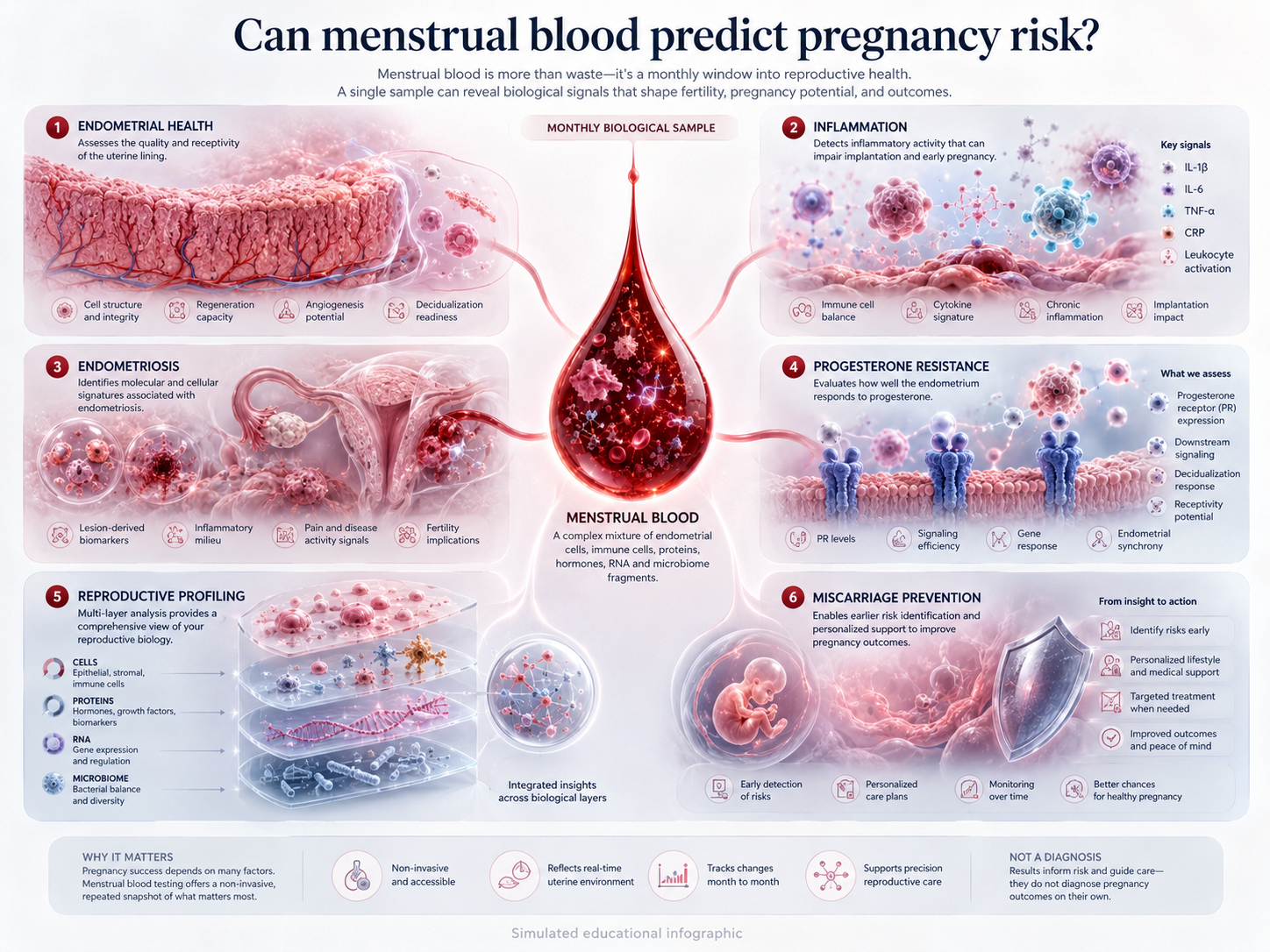
It contains material from the endometrium, the uterine lining that grows, differentiates and sheds during each menstrual cycle.
A menstrual sample may contain:
- blood cells
- endometrial cells
- immune cells
- stromal cells
- epithelial cells
- inflammatory mediators
- hormones and hormone-responsive signals
- tissue fragments
- extracellular matrix material
- microbiome signals
- proteins
- metabolites
- DNA
- RNA
- microRNA
- extracellular vesicles
In other words, menstrual blood may be a monthly liquid biopsy of the reproductive system.
This makes it scientifically interesting.
Not because it gives simple answers.
But because it may provide repeated access to tissue biology that is otherwise difficult to sample.
The Core Hypothesis
The core hypothesis is:
Menstrual blood may contain biological patterns that reflect a woman’s baseline reproductive tissue environment before pregnancy.
Those patterns may include:
- inflammation
- immune activation
- progesterone responsiveness
- endometrial repair
- angiogenesis
- coagulation
- microbiome balance
- oxidative stress
- extracellular matrix remodeling
- endometriosis-associated biology
If these patterns are measurable before pregnancy, they may eventually help identify women whose reproductive tissues are more vulnerable to implantation problems, hematoma formation, miscarriage, placental dysfunction or inflammatory pregnancy complications.
This is not established clinical practice today.
But it is a logical research direction.
From Pregnancy Bleeding to Menstrual Blood
Pregnancy bleeding is a crisis sample.
It is collected after something has happened.
Menstrual blood is different.
It can be collected before pregnancy.
That difference is important.
Pregnancy bleeding may help us reconstruct an event.
Menstrual blood may help us understand predisposition.
One asks:
What happened?
The other asks:
What biology was present before it happened?
This is the shift from forensic interpretation to prevention.
Endometrial Health and Pregnancy Risk
The endometrium is not just a lining.
It is the tissue where implantation begins.
It must:
- grow under estrogen influence
- respond to progesterone
- become receptive to the embryo
- regulate immune tolerance
- remodel blood vessels
- control inflammation
- repair tissue damage
- interact with trophoblast cells
- coordinate early placentation
If endometrial biology is disturbed, pregnancy may be affected from the beginning.
This means menstrual blood may provide indirect access to one of the most important tissues in reproduction.
The question becomes:
Can menstrual blood reveal whether the endometrium is healthy, inflamed, progesterone-responsive or dysregulated before pregnancy begins?
Endometriosis as a Model Disease
Endometriosis is one of the clearest examples of why menstrual blood may matter.
Endometriosis is associated with:
- chronic inflammation
- immune dysregulation
- altered macrophage activity
- oxidative stress
- pain
- abnormal tissue behavior
- progesterone resistance
- altered endometrial receptivity
- fertility problems in some women
Menstrual blood from women with endometriosis may contain signals from this altered reproductive environment.
Possible findings could include:
- inflammatory cytokines
- immune-cell differences
- altered gene expression
- microRNA changes
- oxidative stress markers
- abnormal tissue-remodeling patterns
- endometrial cell dysfunction
This makes endometriosis a natural starting point for menstrual blood research.
If menstrual blood can reflect endometriosis-related biology, it may also reflect broader reproductive inflammatory phenotypes.
Inflammation: The Common Thread
Inflammation appears throughout this entire article series.
It is relevant to:
- endometriosis
- implantation
- decidualization
- hematoma biology
- pregnancy bleeding
- membrane weakening
- preterm birth pathways
- miscarriage risk
- tissue repair
Inflammation is not always harmful.
Controlled inflammation is necessary for normal reproductive function.
Menstruation itself is an inflammatory and repair process.
Implantation also requires carefully regulated immune activity.
The problem is not inflammation itself.
The problem is dysregulated inflammation.
Menstrual blood may help reveal whether the reproductive tract is in a balanced inflammatory state or a chronically activated one.
Progesterone Resistance
Progesterone is central to reproductive health.
It helps transform the endometrium into a receptive, pregnancy-supporting tissue.
This process is called decidualization.
If the endometrium does not respond properly to progesterone, several processes may be affected:
- implantation
- immune tolerance
- vascular stability
- decidual development
- tissue repair
- early placental interaction
Progesterone resistance has been discussed in conditions such as endometriosis.
A key question is whether menstrual blood could reveal signs of poor progesterone response.
Possible signals might include:
- altered expression of progesterone-responsive genes
- abnormal inflammatory markers
- impaired decidualization markers
- altered stromal cell behavior
- changes in tissue-remodeling proteins
This could be one of the most important areas for future reproductive profiling.
Tissue Repair and Remodeling
Every menstrual cycle involves tissue breakdown and repair.
The endometrium sheds.
Blood vessels break.
Matrix is degraded.
Immune cells arrive.
The tissue repairs itself.
This happens repeatedly, cycle after cycle.
Menstrual blood may therefore contain evidence of how the tissue breaks down and how it repairs.
Relevant signals could include:
- matrix metalloproteinases
- collagen fragments
- fibrin and coagulation proteins
- angiogenic factors
- macrophage signals
- epithelial repair markers
- oxidative stress markers
If repair is abnormal, excessive or inflammatory, that may reveal something about the tissue environment.
This matters because pregnancy also requires controlled tissue remodeling.
The same woman whose endometrium repairs poorly during menstruation may have a reproductive tissue phenotype that matters during implantation or early placentation.
The Microbiome Connection
The reproductive tract microbiome may also be visible in menstrual samples.
Menstrual blood passes through the cervix and vagina.
It can pick up microbial signals from the lower reproductive tract.
This may include:
- Lactobacillus dominance
- bacterial vaginosis-associated patterns
- dysbiosis
- Ureaplasma
- Mycoplasma
- inflammatory microbiome signatures
A disrupted microbiome may influence:
- inflammation
- cervical environment
- tissue repair
- membrane biology
- immune signaling
- infection susceptibility
Menstrual blood could therefore become a practical sampling method for studying the reproductive microbiome over time.
Menstrual Blood as a Repeated Monthly Signal
One major advantage of menstrual blood is repetition.
A single sample gives a snapshot.
Repeated samples can show patterns.
For example:
- stable low-inflammatory profile
- recurrent high-inflammatory profile
- cycle-to-cycle microbiome instability
- persistent progesterone-response abnormalities
- repeated oxidative stress signals
- abnormal tissue-remodeling patterns
This is powerful.
Pregnancy bleeding is often a one-time crisis event.
Menstrual blood can be longitudinal.
It may show what is normal for a specific woman before pregnancy occurs.
That personal baseline may become more useful than population averages.
Reproductive Profiling
A future menstrual blood profile could potentially include several layers.
Cellular Profile
- immune cells
- endometrial cells
- stromal cells
- epithelial cells
- macrophage patterns
Inflammatory Profile
- cytokines
- chemokines
- immune activation markers
- inflammatory balance
Hormone-Response Profile
- progesterone-responsive genes
- decidualization markers
- estrogen-response patterns
Tissue-Repair Profile
- matrix remodeling
- angiogenesis
- coagulation
- fibrinolysis
- wound-healing markers
Microbiome Profile
- Lactobacillus dominance
- dysbiosis-associated organisms
- inflammatory microbial communities
Molecular Profile
- DNA
- RNA
- microRNA
- methylation
- extracellular vesicles
Metabolic Profile
- oxidative stress
- lipid mediators
- lactate
- iron-related markers
- energy metabolism
Together, these could form a reproductive fingerprint.
Could This Help Prevent Miscarriage?
This is the most important question.
Miscarriage is common and often multifactorial.
Many causes are genetic and cannot be prevented by reproductive tissue profiling.
But not all pregnancy loss is purely chromosomal.
Some risk may relate to:
- endometrial receptivity
- inflammation
- immune imbalance
- thrombosis
- vascular remodeling
- progesterone response
- microbiome disruption
- placental-interface development
- tissue repair
If menstrual blood can identify some of these patterns before pregnancy, it may eventually help guide preventive strategies.
Possible future interventions might include:
- treating dysbiosis
- reducing chronic inflammation
- improving metabolic health
- addressing endometriosis-associated inflammation
- optimizing luteal phase support
- personalizing progesterone strategies
- monitoring high-risk inflammatory profiles
- planning closer early pregnancy follow-up
This is not about promising that miscarriage can always be prevented.
It is about asking whether some pregnancy risks are visible before pregnancy begins.
Menstrual Blood Versus Pregnancy Bleeding
Menstrual blood and pregnancy bleeding are not the same.
Menstrual blood reflects cyclic endometrial shedding.
Pregnancy bleeding reflects an event during pregnancy.
But they may share biological themes:
- inflammation
- tissue breakdown
- vascular remodeling
- immune-cell activity
- matrix degradation
- hormone response
- microbiome interaction
- blood degradation
- repair
This means menstrual blood may serve as a proxy model.
Not a perfect substitute.
But a pre-pregnancy window into reproductive tissue behavior.
The question is not whether menstrual blood is identical to pregnancy bleeding.
It is whether some biological patterns in menstrual blood predict vulnerability to bleeding, hematoma or pregnancy loss later.
Why This Is a New Kind of Question
Traditional reproductive medicine often evaluates problems after they occur.
Pregnancy loss happens.
Then testing begins.
Bleeding happens.
Then evaluation begins.
Endometriosis symptoms develop.
Then diagnosis is pursued.
But menstrual blood profiling suggests a different model.
Collect information before pregnancy.
Understand the reproductive tissue environment.
Identify risk patterns.
Intervene earlier.
Monitor more intelligently.
This is the shift from reactive medicine to reproductive intelligence.
The AI Connection
Menstrual blood data could be complex.
No single marker will likely predict pregnancy risk.
But AI may help integrate patterns across:
- inflammatory signals
- microbiome data
- hormone-response markers
- tissue-remodeling proteins
- RNA signatures
- clinical history
- menstrual symptoms
- endometriosis status
- previous pregnancy outcomes
A model could learn reproductive phenotypes.
For example:
- inflammatory endometriosis-like profile
- progesterone-resistance profile
- dysbiosis-dominant profile
- abnormal repair profile
- vascular-remodeling profile
- low-risk stable profile
These phenotypes could then be studied against pregnancy outcomes.
This is how menstrual blood could move from curiosity to predictive science.
What We Must Be Careful About
This field must be developed carefully.
Menstrual blood should not be overinterpreted.
Important limitations include:
- cycle variation
- sampling differences
- contamination
- microbiome fluctuation
- hormone-cycle timing
- medication effects
- age
- endometriosis heterogeneity
- lifestyle factors
- lack of validated outcome datasets
Prediction is difficult.
Pregnancy outcomes are complex.
A menstrual profile should not be used to frighten women or make deterministic claims.
The goal should be empowerment, not anxiety.
Better information should lead to better care, not blame.
The Research Roadmap
A serious research program could begin with several groups:
- healthy controls
- women with endometriosis
- women with recurrent pregnancy loss
- women with prior hematoma
- women with prior preterm birth
- women with unexplained infertility
- women planning pregnancy
Repeated menstrual blood samples could be collected before conception.
Then researchers could follow pregnancy outcomes.
The goal would be to ask:
Which menstrual blood patterns are associated with healthy pregnancy?
Which patterns are associated with implantation failure?
Which patterns are associated with miscarriage?
Which patterns are associated with hematoma or bleeding?
Which patterns are associated with placental complications?
This is how the hypothesis becomes testable.
From Understanding to Prevention
The pregnancy bleeding series began with a sample collected during a crisis.
Now it ends with a sample collected before pregnancy.
That is the natural progression.
First:
Can we understand pregnancy bleeding better?
Then:
Can we reconstruct where it came from?
Then:
Can we identify the biological mechanism?
Finally:
Could we have seen risk before pregnancy began?
This is the shift from interpretation to prevention.
The Central Question
The central question is:
Can menstrual blood serve as a pre-pregnancy biological fingerprint?
If the answer is yes, even partially, it could change how we think about reproductive care.
Menstrual blood could become a window into:
- endometrial health
- inflammation
- progesterone response
- tissue repair
- microbiome balance
- reproductive immune status
- pregnancy risk
This does not mean menstrual blood will predict everything.
But it may predict more than we currently imagine.
Conclusion: The First Sample May Come Before Pregnancy
Pregnancy bleeding tells us something after an event has already occurred.
Menstrual blood may tell us something before pregnancy begins.
That is why this idea matters.
Menstrual blood is accessible, repeated and biologically rich.
It may contain clues about inflammation, endometrial health, progesterone response, endometriosis, microbiome balance and tissue repair.
If these clues can be linked to pregnancy outcomes, menstrual blood may become part of a new preventive framework.
A framework where we do not only ask what caused bleeding at week 20.
We ask whether the reproductive tissue environment showed signs of vulnerability long before pregnancy.
That is the larger vision of Pregnancy Bleeding Intelligence.
To move from observing complications to understanding predisposition.
From crisis interpretation to prevention.
From a drop of pregnancy bleeding to a lifelong map of reproductive biology.
References and Resource
1. Single-cell analysis of menstrual endometrial tissues defines phenotypes associated with endometriosis BMC Medicine, published August 2022.
A single-cell study of menstrual effluent showing that menstrual blood contains endometrial cells and immune-cell populations that can differ between women with and without endometriosis.
2. Unlocking uterine biology at home: a validated system for DNA, RNA, and microbiome profiling of menstrual effluent NPJ Women’s Health, published 2025.
This paper presents menstrual effluent as a non-invasive sample containing endometrial tissue, immune cells and microbial communities suitable for molecular profiling.
3. Gene expression of aromatase, SF-1, and HSD17B2 in menstrual blood as diagnostic markers for endometriosis European Journal of Obstetrics & Gynecology and Reproductive Biology, published August 2024.
A study measuring hormone-related gene expression in menstrual blood and evaluating its ability to distinguish women with endometriosis from controls.
4. Progesterone Resistance in Endometriosis: Current Evidence and Putative Mechanisms International Journal of Molecular Sciences, published April 2023.
A review explaining progesterone resistance in endometriosis, including altered progesterone signaling and its possible effects on endometrial function and fertility
5. Endometrial Progesterone and Estrogen Receptors in Relation to Hormonal Levels in Unexplained Recurrent Miscarriage International Journal of Molecular Sciences, published November 2023.
A study examining progesterone and estrogen receptor expression in endometrial tissue from women with unexplained recurrent miscarriage compared with controls